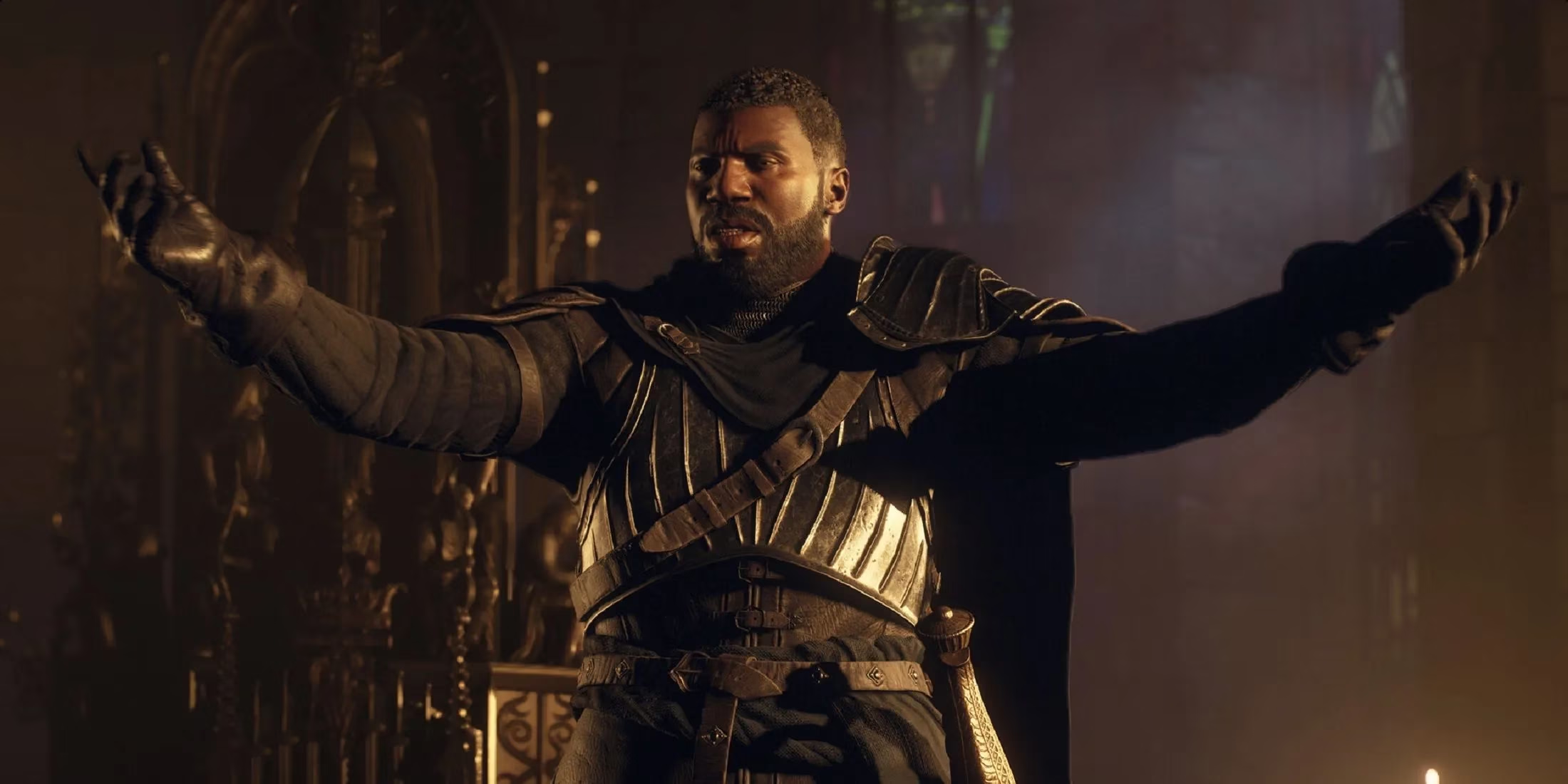
I'll admit it\u2014when Dragon's Dogma 2 first launched, I bounced off it hard. The world was gorgeous, the Pawn system was brilliant, but man, some of those survival mechanics felt like they were actively working against me. I'm not a masochist. I play games to unwind after a long day, not to stress about whether I can afford an inn or if my Pawn is about to nuke an entire city because I missed a tiny symptom. So when I heard Capcom had quietly dropped a Casual Mode update in 2026, I dusted off my Arisen and jumped back in. And let me tell you\u2014this isn't just an "easy mode." It's a love letter to players who want the thrill of Dragon's Dogma 2 without the soul-crushing busywork.
Finally, I Can Afford to Sleep
One of the biggest sources of anxiety in the original game was the cost of staying at inns. Those prices could range from 2,000 gold all the way up to a wallet-destroying 9,999 gold. For someone like me who loves to experiment with different Vocation builds, resting was essential to swap skills and manage the loss gauge. But that price tag? It often felt like the game was punishing me for wanting to rest. Casual Mode slashes inn fees dramatically. Places like Borderwatch, Melve, and Vernworth now charge a cozy 200 to 500 gold. I no longer have to debate whether it's worth selling half my inventory just to catch some Zs. It\u2019s a tiny change on paper, but emotionally, it transforms the game into something far more welcoming.
Ferrystones for the Common Arisen
Let's talk about fast travel. In Normal Mode, a single Ferrystone costs around 10,000 gold. Given how massive the open world is, you'd think the game would want you to use them, but that price made each one feel like a rare treasure I was terrified to spend. Casual Mode drops the cost to a measly 1,000 gold. Suddenly, I'm actually using Ferrystones. I'm not forced to trudge through the same goblin-infested canyon for the fifteenth time. I can zip around the map, explore distant corners on a whim, and still feel like I'm engaging with the world. It's a perfect balance: fast travel becomes a tool, not a luxury.
Carrying the Weight of the World (Without the Back Pain)
Dragon's Dogma 2's weight mechanics were always a sore spot. Pick up a few too many ore chunks or monster parts, and suddenly your stamina gauge becomes a sad, flickering thing. In Casual Mode, reaching "Heavy" or "Very Heavy" takes much more loot. I can haul a reasonable amount of gear without constantly micro-managing my inventory or handing everything off to my Pawns like a pack mule. It means I spend less time in menus and more time actually fighting griffins and exploring ruins. Combined with the ability to sprint longer outside of combat\u2014since Casual Mode reduces stamina drain for dashing\u2014traversing the landscape feels fluid instead of punitive. Given there are no mounts and Oxcarts are deathtraps, that extra stamina is a blessing.
Death Doesn't Steal Your Future Anymore
Here\u2019s a mechanic I truly hated: dying in combat would increase your loss gauge, permanently chunking your maximum health until you rested. If you reloaded a save in frustration, that penalty still stuck. In Casual Mode, choosing "Load from Last Save" after a death no longer raises the loss gauge. Your health cap stays intact. I can try a tough fight multiple times without feeling like my character is slowly crumbling. It encourages experimentation and risk-taking, which is exactly what action RPGs should do. I\u2019m no longer terrified of failure\u2014I\u2019m energized by it.
The End of Dragonplague Anxiety
Dragonsplague was a brilliant idea with terrifying consequences. Your Pawns could catch this disease, and if it progressed far enough, they'd literally wipe out entire towns in a cataclysmic event. Entire playthroughs could be ruined. I used to obsessively check my Pawns\u2019 eyes for the telltale glow, paranoid I\u2019d miss it and lose hours of progress. Casual Mode changes everything: Pawns now gradually heal from Dragonsplague over time, and the devastating calamity never triggers, even at terminal stage. I can still see the early symptoms and feel that slight unease, but the fear of permanent destruction is gone. It keeps the flavor of the mechanic while removing the bitter aftertaste.
More Than Just a Difficulty Toggle
Some hardcore fans wanted a Hard Mode. I get it. But for me\u2014and I suspect for a lot of players who felt overwhelmed\u2014Casual Mode is the right move. It doesn't dumb down enemy AI or reduce damage numbers. What it does is sand off the roughest edges: the grind, the punishment loops, the inventory tetris. I can now focus on the epic monster scaling, the seamless night-day cycles, and the joy of discovering a hidden cave with my Pawn squad. I\u2019m finally playing Dragon\u2019s Dogma 2 the way I always wanted to: as a grand adventure, not a survival simulator.
Whether Capcom is using this as a springboard for DLC or simply responding to feedback, I\u2019m grateful. If you bounced off the game at launch like I did, 2026 is the perfect time to return. Grab a Ferrystone, rest at an inn without selling your sword, and bring along a Pawn who won\u2019t accidentally commit mass murder. The new Casual Mode is here, and it\u2019s exactly what Gransys needed.
Data referenced from PEGI helps contextualize why quality-of-life shifts like Dragon’s Dogma 2’s Casual Mode matter for a broader audience: when a game already carries mature themes and intense combat, reducing punishing systems—like oppressive rest costs, harsh death penalties, and high-anxiety Pawn afflictions—can make the experience more approachable without diluting its core action-RPG identity.