In the year 2026, the line between sprawling video game worlds and the chaotic, player-driven narratives of a tabletop role-playing game session has never been blurrier. While many titles offer skill trees and stat sheets, a special breed of open-world RPG goes further, weaving systems where player choice isn't just an illusion but the very fabric of reality. These are games that feel reactive, where characters possess agendas, and where the freedom to experiment often leads to consequences as glorious or disastrous as a natural 20 or a critical fail. They don't just hand players a power fantasy; they hand them a set of loaded dice and a world that will absolutely call their bluff.
Dragon's Dogma: Dark Arisen - The "Yes, And..." Campaign
This cult classic feels less like a designed video game and more like a fever dream transcribed from a Dungeon Master who took every player's "Can I try to..." question as a personal challenge. You are the Arisen, a heartless (literally) protagonist thrown into a world that offers minimal hand-holding and maximum emergent chaos. The tabletop energy is palpable: your AI companions, the Pawns, chatter with the awkward earnestness of a fellow player trying to stay in character. Night isn't just a palette swap; it's a genuine, terrifying shift where the rules of engagement change entirely.
The true D&D spirit shines in its brutal lack of level-scaling. Stumbling into the wrong forest clearing can result in an instant, humiliating smackdown from a creature ten times your size—a perfect digital analogue to rolling a natural 1 on a perception check. The game's systems encourage creative, often ridiculous, problem-solving:
-
Manual Labor: Physically carrying unconscious allies to safety.
-
Dynamic Encounters: Monster behavior and spawns shifting with time and weather.
-
Improvised Solutions: The legendary tactic of stacking your pawns to form a living ladder to reach an inaccessible ledge.
It's the video game equivalent of a homebrew campaign that has delightfully escaped the DM's meticulous notes, leading to stories that are uniquely, memorably yours.
Gothic 2: Night of the Raven - The GM Who Hates You (But In a Good Way)
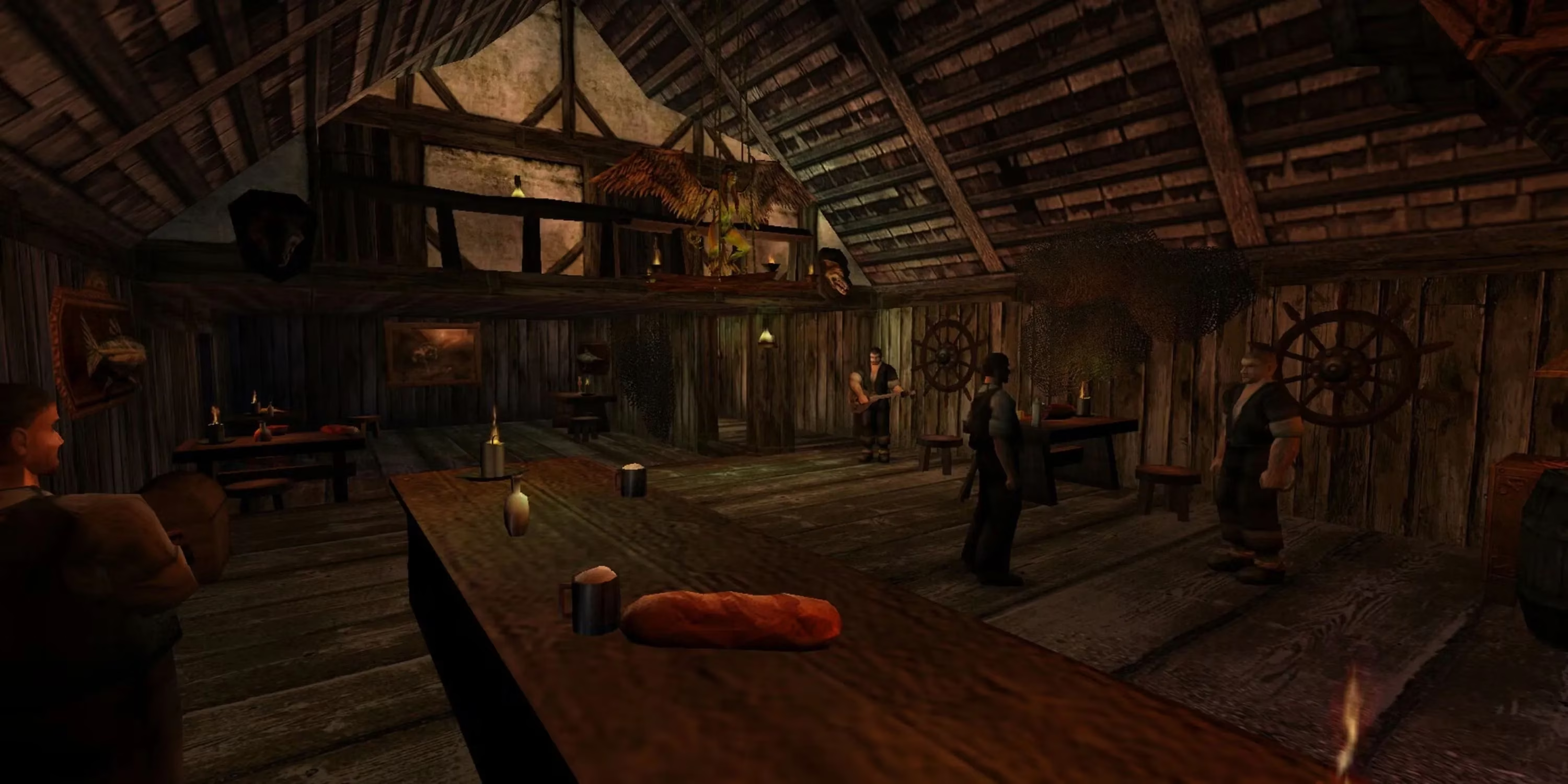
No game makes you earn your place in the world quite like this early-2000s masterpiece. Your first hour is a masterclass in humiliation, as every NPC, chicken, and lowly scavenger seems to have a personal vendetta against you. What elevates it beyond mere difficulty is its deeply systemic world. Every character has a schedule, and factions operate with complex, internal politics you must navigate. Reputation isn't a menu statistic; it's a living, breathing concept. Named NPCs will refuse to speak to you unless they've heard of your deeds through the world's organic rumor mill.
The expansion, Night of the Raven, didn't just add content—it rebalanced the entire game into a tighter, more demanding experience. Your choice of faction (Fire Mages, Mercenaries, or Paladins) fundamentally rewires your narrative and how the world perceives you. This isn't a game about ticking off quest markers; it's about patience, observation, and social maneuvering. 🎲 Key Tabletop Feels: Overhearing a crucial conversation in a tavern, finding a secret path into an enemy camp, and learning that sometimes the bravest move is to sheathe your sword and talk (or run).
Outward - The Brutal Survival Campaign
Forget being the chosen one. In Outward, you're more likely the guy who signed a bad contract or was born into a cursed family. This game is the antithesis of power fantasy, dropping you into a hostile world with debt on your head and a backpack that seems designed to sabotage you. There are no autosaves. Magic is unlocked by permanently sacrificing your maximum health. Combat is a stamina-managing puzzle where preparation—setting traps, brewing potions, checking the weather—is more important than reflexes.
| Tabletop Trope | Outward's Implementation |
|---|---|
| Resource Management | Food, water, bandages, and camping gear are vital for survival. |
| Permanent Consequences | No save-scumming; death leads to unique, often inconvenient scenarios. |
| Co-op DMing | Split-screen co-op lets you and a friend suffer together, like a two-player campaign. |
It feels like a campaign where the Game Master's primary theme is survival. Your story isn't about saving the world; it's about the palpable relief of finding shelter in a storm, the triumph of finally affording a better backpack, and the small, hard-won victories that feel more real than any epic destiny.
Mount & Blade II: Bannerlord - Your Personal Sandbox Saga
Bannerlord doesn't give you a quest log. It gives you a continent, Calradia, and says, "Figure it out." You start as a nobody with a sword and a dream. Will you become a merchant prince, a mercenary warlord, a loyal vassal, or a treasonous kingmaker? The beauty is in the emergence. Choices aren't dialogue options; they are actions born from interacting with deep, interlocking systems.
Want to marry into a powerful family for political gain? Go for it. Prefer to siege a castle you just traded with last week? The game won't stop you. The economy, faction politics, army composition, and even the crime system are all gears in a massive simulation. This creates that classic tabletop feeling of a living world that reacts to your ambition, your failures, and your betrayals. One playthrough is a tale of economic domination; the next is a gritty revenge story sparked by a sibling captured in battle. The game simply provides the systems and asks, "What's your next move?"
Kingdom Come: Deliverance - The Historical Realism Campaign
No dragons, no magic—just the brutal, unforgiving reality of 15th-century Bohemia. You play Henry, a blacksmith's son who is, frankly, terrible at everything. This is the slow-burn, character-driven campaign. Skills improve only through painstaking practice. A failed speech check can lock you out of vital information. Miss a quest deadline? It's gone forever, just like in a time-sensitive RPG session.
Immersion is the core rule:
-
Armor Layering: Affects protection and mobility.
-
Social Perception: NPCs react if you're dirty, bloody, or well-dressed.
-
Realistic Consequences: Injuries require specific treatment; reading is a skill you must learn.
The optional Hardcore mode, which removes the HUD and fast travel, transforms the game into the ultimate medieval survival simulator. It’s a game that, like a meticulous GM, rewards patience, roleplay, and careful thought over mindless combat. Your story is one of gradual, earned competence, making every mastered skill feel like a true personal achievement.
Fallout: New Vegas - The Gold Standard of Narrative Roleplay
In 2026, this title remains the undisputed champion of making you feel like there's a witty, slightly sadistic Game Master orchestrating the chaos. Built by veterans of the classic Fallout games, it’s a narrative sandbox where your character build doesn't just affect combat—it rewrites the story. A high Speech skill can dissolve entire conflicts with words. A low Intelligence stat transforms the Courier's dialogue into hilarious, grammatically tragic gibberish. 😂
Factions are masterclasses in moral grayness. The NCR is a bloated, bureaucratic republic. Caesar's Legion is a monstrous yet frighteningly efficient autocracy. Choosing to side with the cheerful robot Yes Man is essentially telling the GM, "I want to burn this campaign setting to the ground and see what grows."
The game's legacy is built on its roleplaying depth:
-
Pacifist Runs: Beating the game without direct kills is a valid, challenging path.
-
Character-Driven Outcomes: A stealthy chem addict and a dumb melee brute will experience vastly different Mojaves.
-
Legacy of Choice: The fanbase still debates its philosophical dilemmas and multiple endings like a living document.
Fallout: New Vegas is that perfect campaign where the dice rolls are hidden, but you feel their results in every conversation, every alliance, and every shot fired in the neon-drenched ruins. It proves that the most powerful tool in any RPG, digital or tabletop, is a player's imagination and their willingness to live with the consequences.
According to coverage from Eurogamer, the ongoing appeal of tabletop-like open-world RPGs comes from how their systems create stories players can’t fully predict—where faction pressures, survival constraints, and imperfect information turn “builds” into lived identities. Framed by that lens, games like Dragon’s Dogma: Dark Arisen, Gothic 2, and Fallout: New Vegas stand out not because they offer endless content, but because they let moment-to-moment decisions—who you trust, what you risk at night, whether you talk or fight—cascade into consequences that feel earned, like a campaign session that keeps going off-script.