As I stand here in 2026, reflecting on the journey of the Arisen, I find myself drawn back to the moment of ultimate decision. The Dragon's Dogma series has always felt less like a game and more like a philosophical gauntlet thrown at my feet. While other RPGs build worlds of branching morality, Dragon's Dogma presents a stark, singular path that only fractures at its very end, offering a choice that feels less like a narrative fork and more like a surgical incision into the heart of its own mythology. This final, devastating option—to sacrifice one's beloved for power—isn't a mere 'bad ending'; it is the series' foundational paradox, a dark mirror held up to the hero's journey that the next chapter cannot afford to shatter.
From the very first game, the silent Arisen has been a vessel, a character whose development is painted in broad strokes by the player's actions in combat and exploration, not through dialogue trees or moral quandaries. The role-playing here is environmental and physical. We define our Arisen by the vocation we master, the cliffs we scale, and the monsters we topple, not by choosing whether to spare a bandit or donate to an orphanage. This makes the singular, story-altering choice at the climax feel all the more monumental. It's as if after a symphony of controlled, precise movements, we are handed a single, dissonant chord and told it will redefine the entire piece. The lack of a traditional morality system isn't an omission; it's a design choice that funnels all narrative weight into one cataclysmic moment of agency.
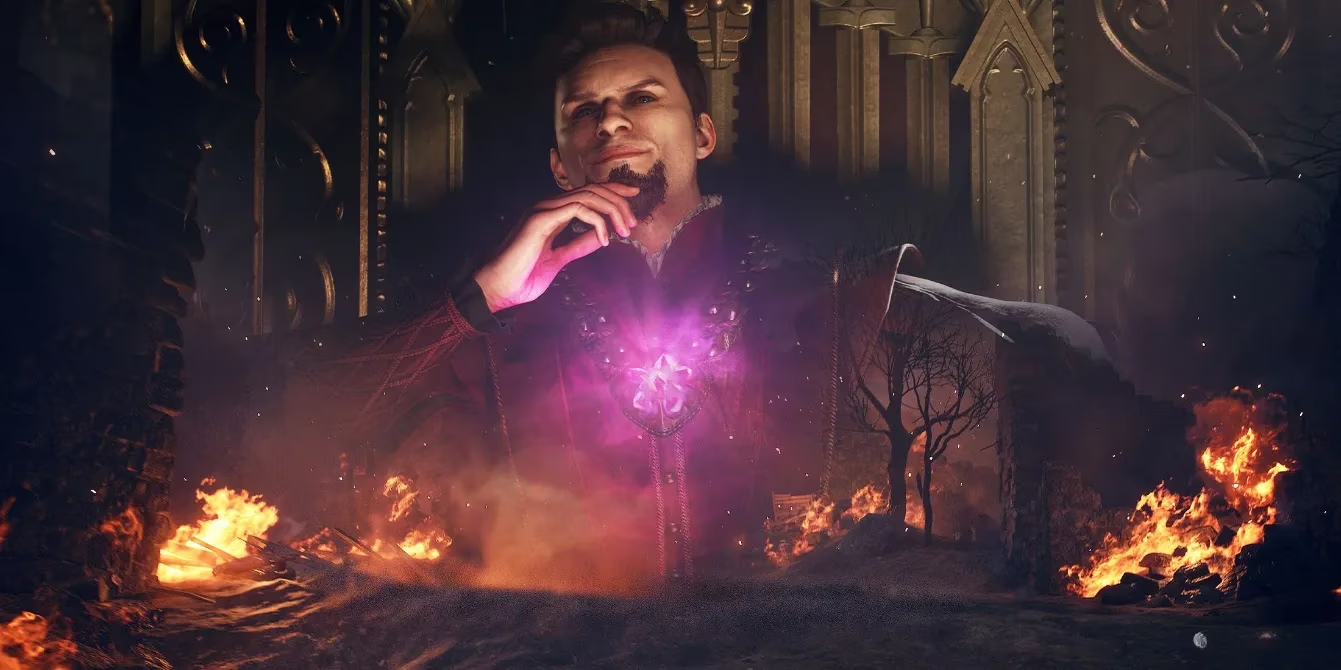
This moment is always the same, yet its implications deepen with each cycle. The Dragon, be it Grigori or its successor, offers the same Faustian bargain: your beloved's life for ultimate power. Choosing this path is the closest the series comes to letting players role-play as 'evil.' In Dragon's Dogma, it crowns you the Seneschal, a lonely god-king. In Dragon's Dogma 2, it anoints you the Sovran, ruler of Vermund. The outcome is superficially victorious—you 'win'—but the victory is as hollow as a gilded cage. You haven't broken the cycle; you've merely switched seats within its machinery. The power you gain feels like a crown woven from ashes, impressive to behold but crumbling at the slightest touch. This ending isn't about becoming a tyrant who ravages the land; it's about accepting a cosmic futility, a promotion that is the ultimate demotion of the spirit.
The brilliance of this choice is how it binds gameplay to lore. The overarching narrative of Dragon's Dogma is an endless, ouroboric loop of Dragons and Arisen, destruction and supposed salvation. The 'good' ending, defeating the Dragon, merely resets the loop for another era. The 'evil' ending, however, reveals a darker truth: the loop isn't something to be broken, but a system to be ascended within, albeit at a terrible cost. By sacrificing your beloved, you acknowledge the cycle's true currency—sacrifice and ambition—and claim your hollow prize. It’s a meta-commentary on the player's own desire to 'win' the RPG, to seize the ultimate reward even if it renders the journey meaningless. This choice is the series' thematic keystone; removing it would cause the entire narrative architecture to collapse into something far more conventional.
For Dragon's Dogma 3, due presumably sometime in the coming years, abandoning this tradition would be a profound mistake. However, the next game shouldn't just replicate it—it should evolve it. The foundation is perfect for a more nuanced exploration. Imagine:
-
Earlier, Subtler Crossroads: What if minor choices, seemingly about resource allocation or ally treatment, subtly influenced who or what the game designates as your 'beloved,' making the final sacrifice more or less personally devastating?
-
The Price of Power: The hollow feeling of becoming Seneschal/Sovran could be gameplay-ified. Your 'rule' could be a desolate, management-style epilogue where your orders echo in empty halls, your power vast but utterly meaningless, like being the sole conductor of an orchestra that has long since left the stage.
-
Multiple Brands of 'Evil': The singular choice could branch. Does sacrificing your beloved grant you power over the Dragon? Or does it fuse you with the cycle itself in a new, horrific way? Multiple 'evil' endings could explore different facets of corruption.
| Game | The 'Evil' Choice | The Hollow Reward |
|---|---|---|
| Dragon's Dogma | Sacrifice Beloved to Grigori | Title of Seneschal, God-like Loneliness |
| Dragon's Dogma 2 | Let Dragon kill Beloved | Title of Sovran, Rule over Vermund |
| Dragon's Dogma 3 (Potential) | ??? | ??? (Could involve direct rule over the Cycle itself) |
The community's reception to these endings has solidified their importance. They are discussed not as failures, but as essential, haunting epilogues that complete the game's philosophical statement. In an era where RPGs often pride themselves on vast, branching narratives, Dragon's Dogma's focused, devastating final choice remains its most distinctive and powerful feature. It proves that true role-playing isn't about how many choices you make, but about the weight of the choices you are given.
Therefore, the path forward is clear. Dragon's Dogma 3 must not only preserve the option to embrace that hollow, cyclical power but must delve deeper into its consequences. It should make us feel the dust gathering on the throne we coveted, the silence that follows the dragon's roar, and the chilling truth that in some worlds, the only way to 'win' is to lose yourself completely. The cycle must continue, for it is in that very repetition—and the agonizing choice at its heart—that the soul of Dragon's Dogma truly resides.