As a professional gamer, I've seen trends come and go, but nothing, and I mean NOTHING, has blown my mind in 2026 like the sheer, unadulterated, unpredictable chaos that defines the emergent gameplay in STALKER 2 and Dragon's Dogma 2. On the surface, you've got a grim, radioactive survival horror and a majestic, high-fantasy epic—polar opposites in the gaming cosmos. Yet, here I am, screaming at my monitor in equal parts terror and delight because both games have mastered the same dark art: creating stories that aren't just played, but that happen to you. It's the gaming equivalent of a controlled explosion where you're both the arsonist and the firefighter, and it's glorious.
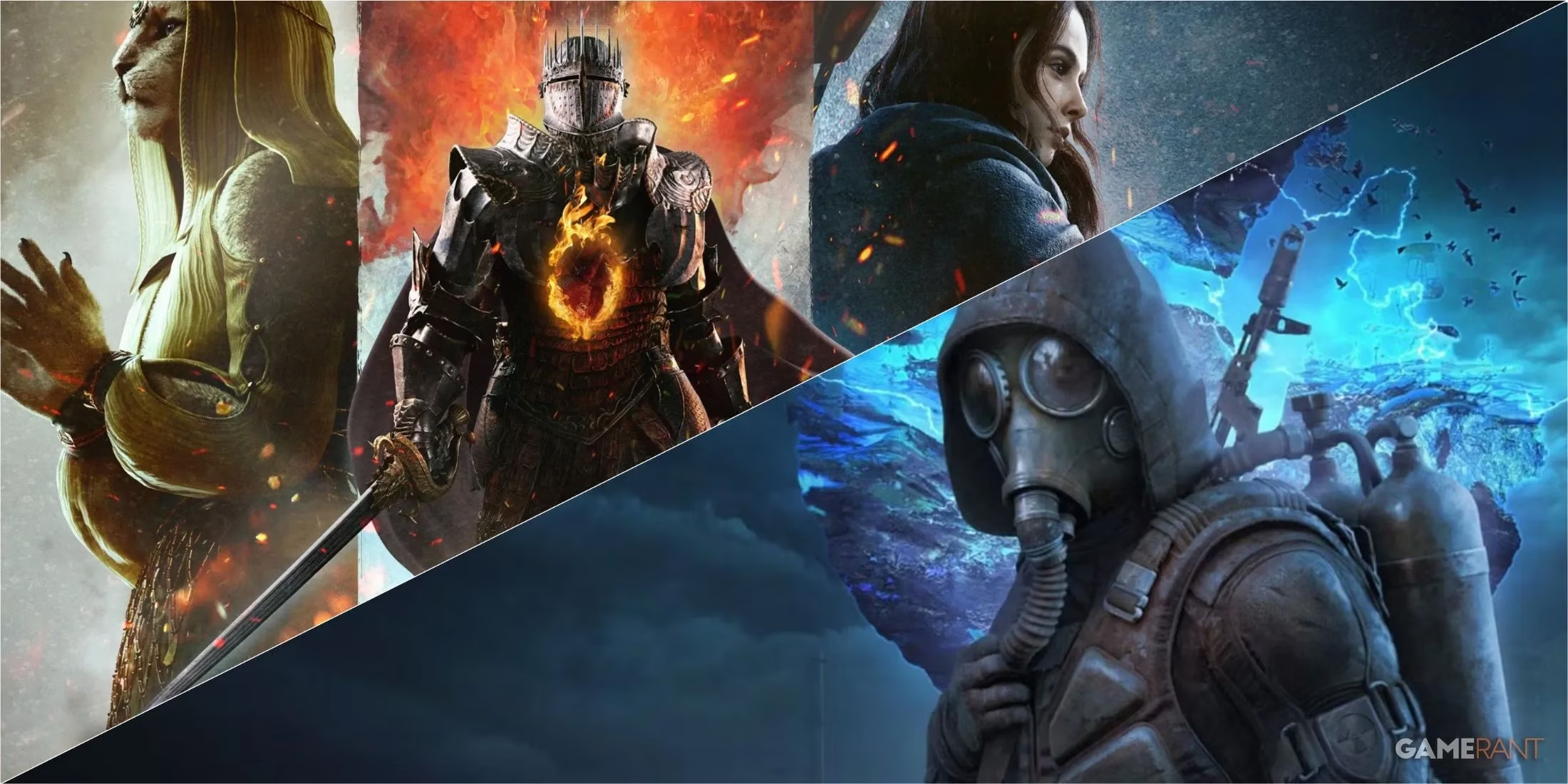
The Heart of the Chaos: Defining "Emergent" in 2026
Let's get this straight. In 2026, "emergent gameplay" isn't just a buzzword; it's the holy grail of player agency. It's when the game's rules, systems, and artificial intelligence collide in a beautiful, unscripted symphony of pandemonium. It's the magic that occurs when you're not following a quest marker, but creating your own legend through pure, systemic interaction. This can manifest in two brilliant ways:
-
Player-Led Emergence: This is where YOU, the maestro of mayhem, pull the strings. It's about exploiting the game's physics, ecology, and enemy behaviors to solve problems in ways the developers never explicitly told you about.
-
AI-Led Emergence: This is where the game's world lives and breathes without you. Factions feud, monsters migrate, and random events unfold in the background, creating a dynamic tapestry that makes every playthrough unique.
The genius of both STALKER 2 and Dragon's Dogma 2 is how they seamlessly blend these two forms into one cohesive, breathless experience.
STALKER 2: Survival by Any Means Necessary in The Zone
Stepping back into the Chornobyl Exclusion Zone in STALKER 2 isn't just a game—it's a tense, atmospheric battle for survival where every decision has weight. The emergent gameplay here isn't a feature; it's the law of the land.
My most memorable moment? I was being hunted by a pack of Bloodsuckers near an abandoned factory. Outgunned and low on ammo, I remembered a nearby nest of volatile Pseudodogs. I fired a shot into the air, leading the Bloodsuckers right into the Pseudodogs' territory. What followed wasn't a scripted cutscene; it was a brutal, AI-driven wildlife brawl. As the mutants tore into each other, I used the distraction to sprint past, only for a sudden Emission to roll in. The blinding psionic storm caught the last surviving Bloodsucker mid-leap, frying it in a crackling burst of energy. I didn't "win" that encounter; I orchestrated a disaster and barely escaped the fallout. The game's friendly faction members, like Duty or Freedom, add another layer, often jumping into firefights unasked, turning a simple skirmish into a full-scale, three-way battlefield.
Key Emergent Tools in STALKER 2:
| System | Emergent Effect |
|---|---|
| Mutant & Faction AI | Creates dynamic, unpredictable conflicts between NPC groups. |
| Anomalies (Gravitational, Electrical, etc.) | Environmental hazards that can be weaponized against enemies. |
| A-Life System 2.0 | The world simulation that drives creature behavior and faction movements globally. |
Dragon's Dogma 2: Where Fantasy Clashes with Free Will
If STALKER 2's emergence is about desperate survival, Dragon's Dogma 2's is about spectacular, heroic chaos. The world of Vermund is a living, breathing fantasy painting where your Pawns are the wildcard that makes everything infinitely more interesting (and hilarious).
I was on a simple quest to clear goblins from a hillside. Easy, right? Wrong. My main Pawn, a mage with a death wish, decided to aggro a Griffin nesting on a nearby cliff. As the majestic beast dove into the fray, its massive wings scattered the goblins and set the grass on fire. Suddenly, an Ogre, attracted by the noise, came barreling down from the forest. For five glorious minutes, it wasn't "me versus enemies." It was a free-for-all royal rumble: Griffin vs. Ogre, goblins caught in the crossfire, my Pawns healing the Ogre by mistake, and me, the supposed Arisen, desperately trying to climb the Griffin while everything burned around me. The Pawn system is the ultimate emergent engine—their "free will" constantly creates novel, unforgettable combat scenarios.
Iconic Emergent Moments in Dragon's Dogma 2:
-
The Cyclops Stampede: Luring a Cyclops into a bandit camp and watching it use the bandits as clubs.
-
Pawn Pandemonium: Your Pawn suddenly grabbing a Saurian and throwing it off a cliff, completely altering the battle's flow.
-
Monster Ecology in Action: Seeing a Drake and a Chimera fight for territory, allowing you to scavenge the remains.
The Unlikely Symphony: Why These Two Titans Stand Together
So, what do a grim shooter and a vibrant RPG truly share? It's a profound philosophy of player-authored narrative. Both games provide a toolbox of deep, interacting systems (AI, ecology, physics, companion behavior) and then have the courage to step back. They don't hand you a script; they hand you a sandbox of dynamic elements and say, "Make your own fun." The thrill isn't in completing a checklist; it's in the stories you tell afterward: "You won't believe what just happened in The Zone..." or "My Pawn did the craziest thing today..."
In an era where many games feel overly curated and safe, STALKER 2 and Dragon's Dogma 2 are bold, chaotic, and deeply rewarding. They prove that the most powerful tool in a game isn't a legendary sword or a high-tech rifle—it's a world that feels truly alive, reacting to your presence in ways that surprise even its own creators. For any gamer in 2026 craving an experience that is uniquely theirs, these two masterpieces are not just games; they are engines for generating personal legends. Now, if you'll excuse me, I have to go see if I can lure a Boreas into a Bandit camp in Dragon's Dogma 2. For science, of course. 😉