As we navigate the gaming landscape of 2026, the age-old debate about voiced versus silent protagonists continues to spark passionate discussions among developers and players alike. For me, this isn't just about character design—it's about immersion, storytelling philosophy, and how we connect with digital worlds. The choice between a speaking hero and a silent avatar isn't about what's better universally, but what serves the game's soul. Some narratives cry out for a voiced lead, while others find their magic in the quiet spaces where players fill the silence with their own interpretations. It's a delicate dance between developer vision and player agency that defines some of our most memorable gaming experiences.
The Elder Scrolls V: Skyrim: Where Silence Speaks Volumes
Bethesda's masterpiece, now celebrating its 15th anniversary with next-gen enhancements, remains the gold standard for silent protagonists in open-world RPGs. The Dragonborn's silence isn't an absence—it's an invitation. When I first stepped into Whiterun back in 2011, I didn't just play a character; I became them. The text-based dialogue system, while showing its age in some modern implementations, creates this beautiful paradox: through choosing written responses, my character felt more real than many fully-voiced protagonists I've encountered since.
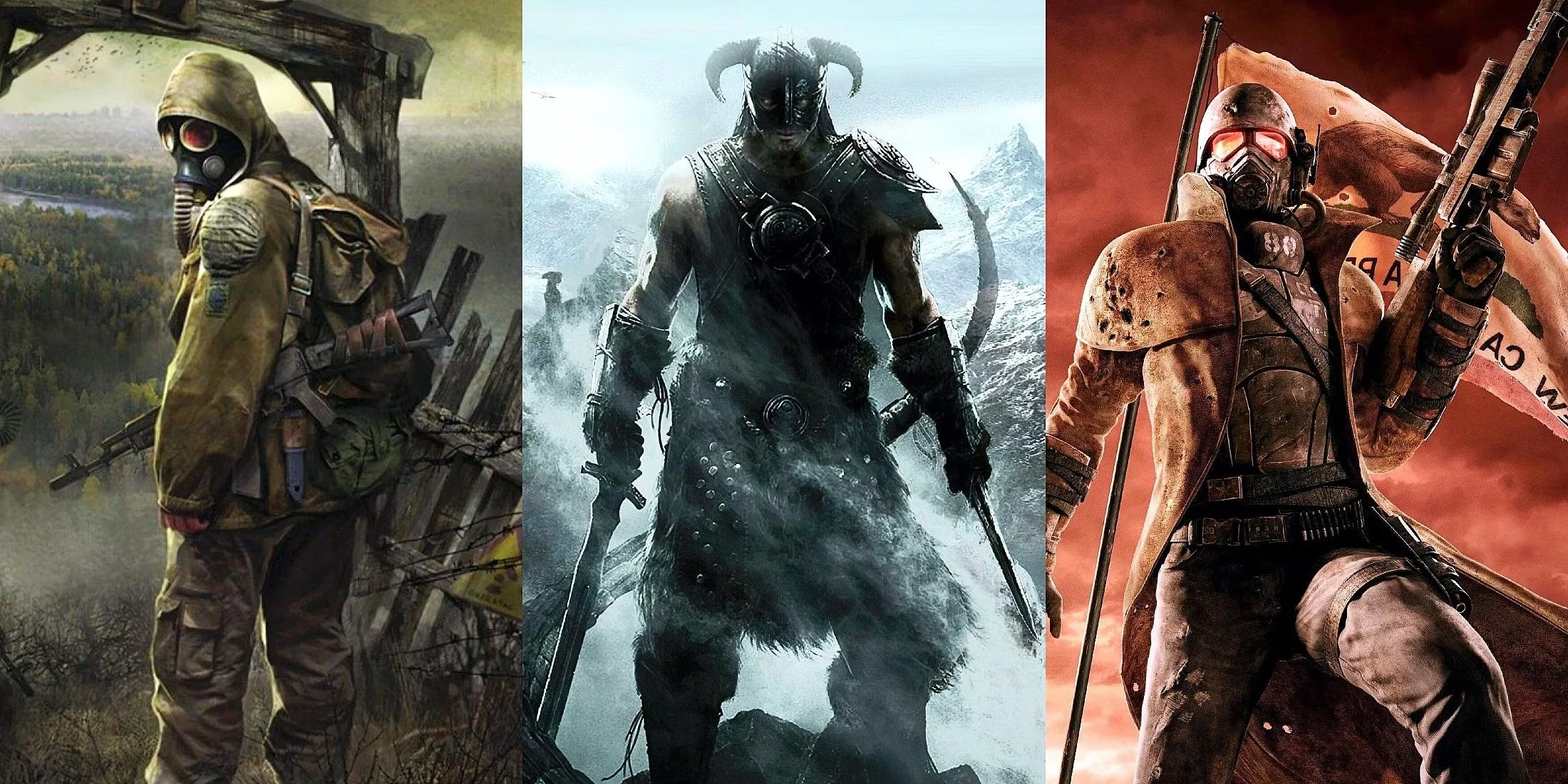
What makes Skyrim's approach work so brilliantly:
-
Complete character ownership: From Nord warrior to Khajiit thief, the silence lets players project their own voice
-
Uninterrupted immersion: No sudden commentary breaks the atmospheric exploration of Tamriel's frozen peaks
-
Timeless design: The 2026 anniversary edition proves this approach still resonates with new generations
The modding community has kept this conversation alive too—while some mods add voice acting, the most popular ones enhance the silent experience with better animations and dialogue systems. It's clear that for many of us, Skyrim's quiet hero isn't a limitation but a feature.
FromSoftware's Quiet Revolution: Elden Ring's Silent Tarnished
FromSoftware's magnum opus didn't just redefine open-world design—it perfected the art of meaningful silence. Playing as the Tarnished in 2026, with all DLC content expanding the Lands Between, I'm struck by how much communication happens without words. The gesture system isn't just for memes (though the 'point forward' emote has become gaming's universal 'go that way' signal); it's an entire language that feels more authentic than pages of dialogue.
Elden Ring's silent strengths:
-
Environmental storytelling: Every ruin whispers history without exposition dumps
-
NPC minimalism: Characters like Ranni speak volumes with few words, making every interaction precious
-
Player expression: My Tarnished's silence became a canvas for my own reactions to the game's tragedies and triumphs
What's fascinating in 2026 is seeing how other games have adopted this 'show, don't tell' philosophy. The industry has moved toward more environmental storytelling, and Elden Ring's success proved that players don't need constant narration to feel connected to a world.
The Zelda Legacy: Link's Eternal Silence
Breath of the Wild and Tears of the Kingdom didn't just revolutionize open-world design—they reaffirmed that some icons are defined by what they don't say. Playing through the newly announced "Echoes of the Sacred Realm" expansion for Tears of the Kingdom, I'm reminded why Link's silence works so perfectly. He's not an empty vessel; he's a mirror reflecting the player's wonder at Hyrule's beauty and horror.
| Game | Year | Why Silence Works |
|---|---|---|
| Breath of the Wild | 2017 | Exploration-focused design |
| Tears of the Kingdom | 2023 | Player-driven narrative |
| Upcoming Title | 2027 | Series tradition meets innovation |
The Creating a Champion book's explanation—that Link's knightly dedication has made him stoic—adds depth without breaking the magic. In 2026, with AI-generated dialogue becoming more common, there's something refreshing about a hero who communicates through action rather than words.
When Silence Stumbles: The Far Cry 5 Dilemma
Let's keep it real—not every silent protagonist lands perfectly. Far Cry 5's Deputy felt... awkward. In a game where charismatic villains monologue directly at you, sitting there mute sometimes broke immersion rather than enhancing it. The dissonance was real when characters like Joseph Seed would deliver these intense speeches to my silent Rook.
The evolution of Far Cry's approach:
-
Far Cry 5 (2018): Silent protagonist, mixed reception
-
Far Cry 6 (2021): Voiced Dani Rojas, more cinematic
-
Industry trend: Moving toward player choice in protagonist expression
Ubisoft's pivot to voiced protagonists in Far Cry 6 and beyond shows how developer philosophy evolves. Sometimes, what works in one genre (RPGs) feels off in another (narrative FPS). In 2026, we're seeing more games offer options—toggleable protagonist commentary, or systems where silence or speech changes based on player choices.
STALKER's Contrast: From Silent Strelok to Voiced Skif
The STALKER series presents a fascinating case study. Playing through the complete STALKER 2: Heart of Chornobyl experience in 2026, with all its graphical enhancements and expanded Chernobyl Exclusion Zone, I appreciate both approaches. The original's silent Marked One created this eerie, disconnected feel perfect for the Zone's atmosphere. But Skif's voice in the sequel? Chef's kiss for the more cinematic narrative.
What's brilliant is how the sequel handles legacy: Strelok returns as a voiced NPC, creating this meta-commentary on how we perceive silent versus voiced characters. The Zone feels different with a protagonist who reacts audibly to its horrors, but both approaches serve their games' tones perfectly.
Fallout's Divided Legacy: New Vegas vs. Fallout 4
As someone who's sunk hundreds of hours into both games (and modded them into entirely new experiences in 2026), I understand both sides of this debate. Fallout: New Vegas's silent Courier allows for incredible role-playing flexibility—I've played everything from smooth-talking diplomat to psychotic chem-addict, all feeling authentic.
Fallout 4's voiced Sole Survivor, while controversial, brought emotional moments that silent protagonists struggle to achieve. That first cry upon seeing the ruined Commonwealth? Powerful stuff. The 2026 modding scene shows the community's divided heart: some mods restore silent protagonist options, while others expand voice acting.
Key differences in approach:
New Vegas: Text responses → Player imagines delivery

Fallout 4: Voiced lines → Consistent emotional tone

Both valid, different experiences
Dragon's Dogma 2: Old-School Silence in a Modern Package
Capcom's 2024 masterpiece (still going strong in 2026 with seasonal updates) proves that silent protagonists aren't just for nostalgia trips. The Arisen's silence fits perfectly with the game's focus on action and exploration over dialogue. Creating my Arisen and Main Pawn felt like true character ownership—their personalities emerged through combat styles and pawn commands rather than words.
What Dragon's Dogma 2 understands is that silence can be active. My Arisen communicated through:
-
Combat decisions and tactics
-
Pawn management and training
-
Exploration choices in that brutal, beautiful world
The lack of constant chatter made discoveries feel more personal, more earned.
Shadow of the Colossus: Silence as Art
Playing the 2026 ray-traced remaster of this classic, I'm reminded that some games treat silence not as a design choice but as an artistic statement. Wander's wordless journey isn't about player projection—it's about creating a specific emotional tone. The minimalism amplifies everything: the loneliness, the scale, the moral ambiguity of hunting colossi.
In an era where games often over-explain, Shadow of the Colossus trusts players to sit with uncomfortable silence, to feel the weight of actions without verbal justification. It's a reminder that sometimes, the most powerful stories are those left partially untold.
The Future of Silent Protagonists in 2026 and Beyond
Looking at the gaming horizon, I see exciting developments:
🚀 AI integration: Games are experimenting with AI that adapts to whether players prefer silent or responsive protagonists
🎮 Hybrid systems: Some 2026 releases offer toggleable protagonist voices, or systems where characters remark only on significant discoveries
🌍 Cultural shifts: As gaming becomes more global, silent protagonists offer localization advantages, though cultural differences in reading preferences challenge this
📊 Player data trends: Analytics show interesting patterns—hardcore RPG fans prefer silence, while narrative-focused players lean toward voiced protagonists
The truth is, both approaches have their place. What excites me about 2026's gaming landscape is the increasing sophistication in how games handle player identity. Whether through silent avatars we fill with ourselves or voiced characters we journey alongside, the best games understand that connection is what matters most.
At the end of the day, it's not about silent versus voiced—it's about giving players experiences that resonate. And sometimes, the loudest statements are made in perfect silence. 😌✨