Is an open-world game truly worth the investment if its exploration feels hollow and unrewarding? Many titles promise satisfying discovery, but only a select few master the art of making every hidden corner, every distant vista, and every uncovered secret feel genuinely meaningful. True rewarding exploration isn't confined to a single genre; it's a design philosophy that can transform a game from a simple pastime into an unforgettable journey. From the depths of alien oceans to the sprawling ruins of forgotten civilizations, these games prove that the joy of discovery is one of gaming's most powerful and enduring pleasures.
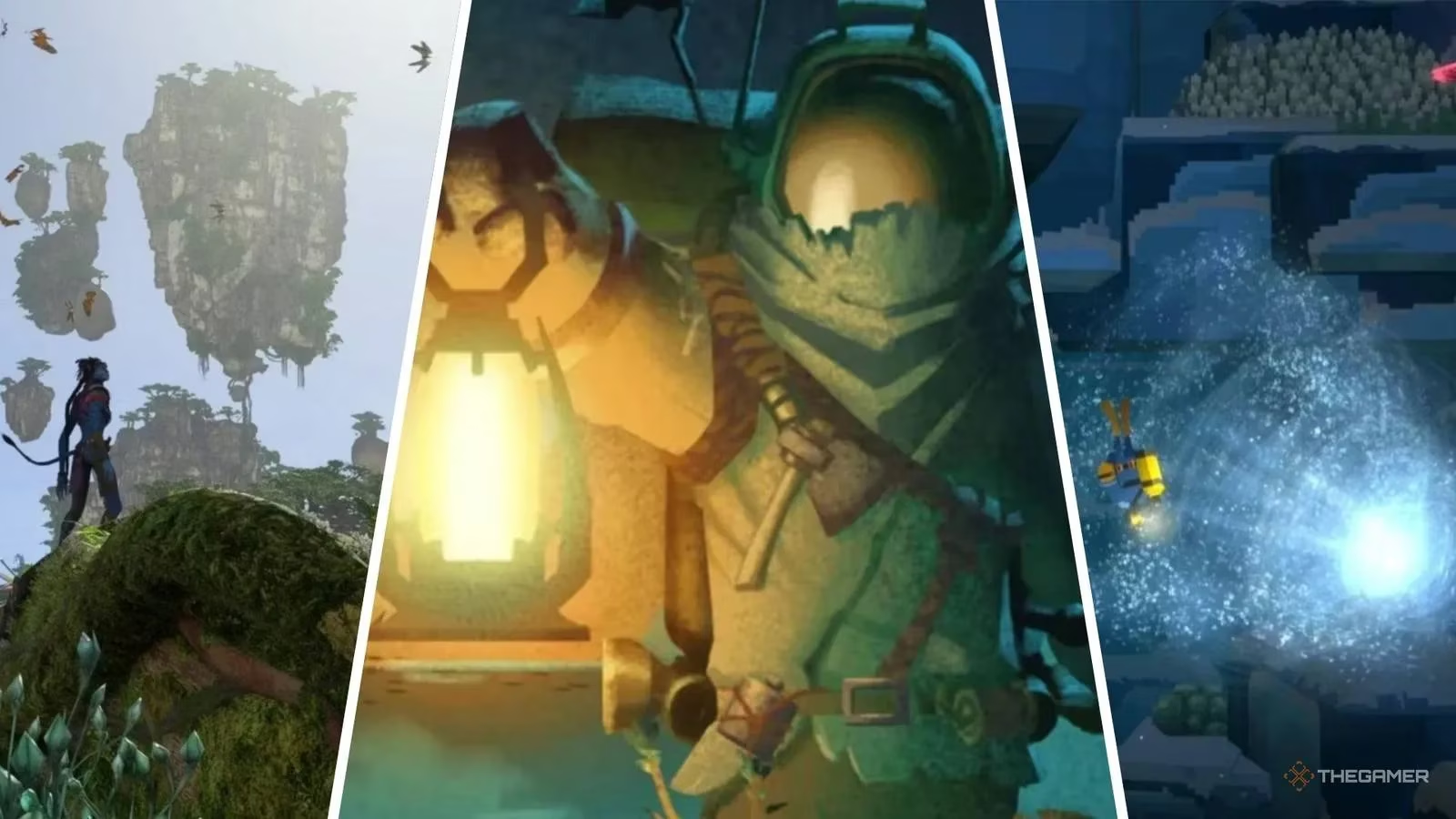
Ever dreamed of running a sushi bar by night while hunting for its ingredients in a mysterious, ever-changing ocean by day? That's the delightful premise of Dave the Diver. This indie gem makes deep-sea exploration feel wondrous and directly impactful. The main playground is the enigmatic Blue Hole, a zone teeming with vibrant sealife, mysterious regions, and light combat. The genius lies in the loop: the exotic fish you risk your life to catch become dishes that delight your customers, whose feedback directly fuels your next dive. Exploration here isn't just sightseeing; it's the core engine of your small business's success, making every discovery deliciously rewarding.
Assassin's Creed Odyssey transports players to the breathtaking beauty of Ancient Greece. Launched between Origins and Valhalla, this entry perfected a balance of story, exploration, and pacing. The world is vast, dotted with question marks hinting at hidden activities, side quests, enemy camps, and legendary creatures. Yet, the reward isn't just experience points; it's the sheer awe of standing before meticulously recreated temples, sailing across turquoise seas, and uncovering the sprawling conspiracy of the Cult of Kosmos. You gain XP just for exploring, encouraging you to stray from the beaten path and soak in every historical vista.
While Avatar: Frontiers of Pandora might not match the narrative heights of James Cameron's films, it excels in making you feel like a Na'vi exploring their homeworld. Its most underrated feature is the Immersive Exploration Mode. Activating it removes all quest markers from your map. You navigate using only environmental clues, written directions, and your own senses, making the alien jungles, floating mountains, and bioluminescent forests feel truly unknown and magical. This mode transforms simple travel into a challenging and deeply engaging act of discovery, perfectly capturing the wonder of Pandora.
Don't let the cute, hand-drawn aesthetics fool you. Hollow Knight is a masterclass in atmospheric, rewarding exploration in the Metroidvania genre. The fallen kingdom of Hallownest is a dense, interconnected web of stunning and haunting areas, from the fungal groves of Fungal Wastes to the silent, regal ruins of the City of Tears. Exploration is rewarded not just with new lore snippets and hidden stories told through the environment (in true Souls-like fashion) but with crucial new abilities. Each new power—a dash, a wall-jump, a spell—retroactively opens up previously inaccessible paths, making every discovery feel like a key to a grander, more mysterious world.
Outer Wilds is a singular experience in gaming, and its praise is wholly deserved. Its exploration is built around a haunting, beautiful 22-minute time loop. ⏳ Every loop, you explore a handcrafted solar system, uncovering the mysteries of the ancient Nomai civilization. Knowledge is your only permanent progression. Learning how to reach a hidden quantum moon or understanding a distant signal doesn't just mark a checkbox; it fundamentally changes how you perceive and navigate the world in your next loop. The reward is the profound "aha!" moment, the piece of a cosmic puzzle clicking perfectly into place.
In Dragon's Dogma 2, the journey is unequivocally the destination. The game actively discourages fast travel through a deliberate design choice: Ferrystones are rare, and Portcrystals must be found and placed. This design philosophy pushes you into the wild, where the real magic happens. The world is filled with dynamic, unscripted encounters—a griffon might snatch you off a cliffside, a cyclops can be tricked into breaking down a fort's gate, and traveling at night becomes a perilous, thrilling endeavor. Exploration here is rewarded with emergent, unforgettable stories you create yourself, not just with loot in a chest.
On the other end of the spectrum, Red Dead Redemption 2 pairs its stellar, emotionally charged narrative with a world so dense and alive that exploration feels like a privilege. Rockstar crafted an unparalleled level of detail in this fictionalized version of the American frontier. Riding through the world as Arthur Morgan, you'll stumble upon hidden serial killer lairs, chance encounters with strange strangers, serene natural landmarks, and quiet moments of wildlife interaction that are never marked on your map. The reward is immersion itself—the feeling that you are living in, not just playing through, a breathing, changing world.
Elden Ring, and its massive expansion Shadow of the Erdtree, took the cryptic storytelling of Soulsborne games and placed it in a vast, open world. The Lands Between and the Realm of Shadow are littered with fragments of a grand mythology. There is a deep, tragic story woven into the world, its characters, and its monstrous inhabitants, but none of it is handed to you. You must seek it out. Reading item descriptions, deciphering environmental storytelling, and talking to cryptic NPCs are all acts of exploration. The reward is the profound satisfaction of piecing together a cosmic puzzle, uncovering hidden legacy dungeons, and finding legendary weapons that other players might completely miss.
In Baldur's Gate 3, exploration is the very heartbeat of the experience. You can miss entire companion characters, major story arcs, and game-changing abilities simply by not thoroughly canvassing an area. ♂️ Interacting with every NPC, investigating every suspicious bookcase, and venturing down every side path is where the game's magic truly lives. The density of meaningful content is staggering, and the branching narratives ensure that no two playthroughs uncover the same secrets. The reward is a deeply personal story shaped entirely by your curiosity (or lack thereof).
Finally, No Man's Sky offers a scale of exploration that is literally astronomical. The promise of 18 quintillion procedurally generated planets is more than a gimmick; it's an invitation to a near-infinite journey. With constant, substantial updates, the game has evolved into a rich tapestry of interstellar discovery. Exploration is core to its survival, base-building, and narrative mechanics. Scanning new flora and fauna, discovering bizarre planetary biomes, and uncovering ancient alien artifacts directly contribute to your progression and understanding of the universe. The reward is the sheer, childlike wonder of being a true pioneer, landing on a world no one—not even the developers—has ever seen before.
| Game | Primary Exploration Reward | Key Feature |
|---|---|---|
| Dave the Diver | Business Success & New Recipes | Day/Night loop tying exploration to management |
| Assassin's Creed Odyssey | Historical Wonder & XP | Vast, beautiful recreation of Ancient Greece |
| Avatar: Frontiers of Pandora | Immersion & Challenge | Immersive Exploration Mode (no markers) |
| Hollow Knight | New Abilities & Lore | Interconnected world with ability-gated progression |
| Outer Wilds | Knowledge & Puzzle-Solving | 22-minute time loop where knowledge is progression |
| Dragon's Dogma 2 | Emergent Stories & Encounters | Deliberately limited fast travel promoting organic discovery |
| Red Dead Redemption 2 | Immersion & World Detail | Unparalleled environmental storytelling and random events |
| Elden Ring | Lore Understanding & Hidden Bosses | Cryptic, environmental storytelling in an open world |
| Baldur's Gate 3 | Branching Narratives & Companions | Dense, choice-driven world where exploration defines the story |
| No Man's Sky | Infinite Discovery & Progression | Virtually infinite, procedurally generated universe |
Ultimately, the most rewarding exploration in games does more than fill a map with icons. It ties discovery directly to emotion, progression, and narrative. It makes the player feel like a true adventurer, where the next hill, cave, or star system might hold the key to a new understanding, a powerful tool, or simply a moment of breathtaking beauty. In 2025, these titles stand as benchmarks, proving that when exploration is done right, it becomes the very soul of the adventure.