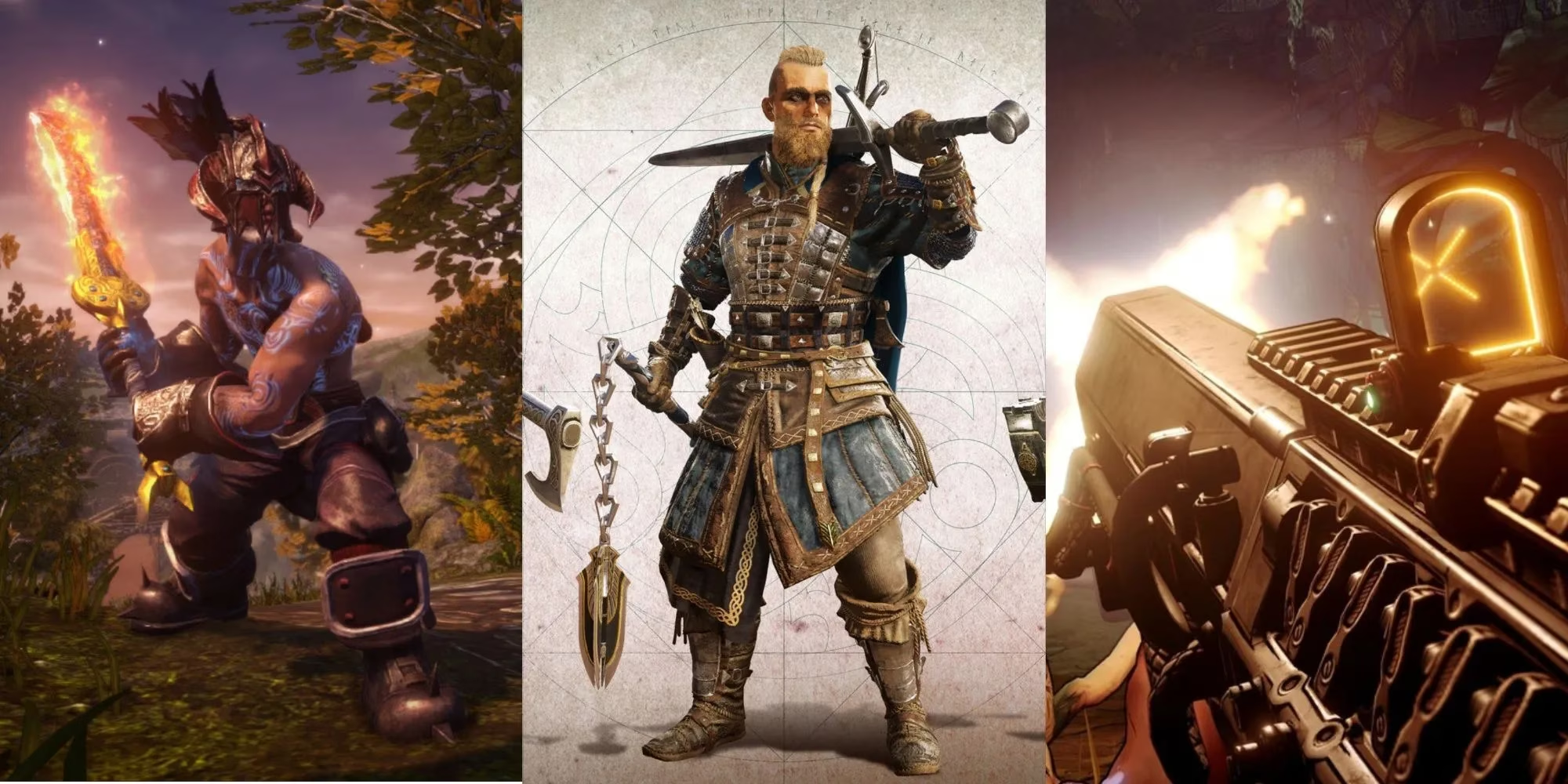
In the boundless realms of open-world gaming, a hero’s journey is rarely defined by dialogue trees alone. Instead, it is the arsenal clutched in trembling hands—whether a blade humming with ancient enchantments or a jury-rigged cannon that hurls garden gnomes—that carves the most vivid stories. By 2026, players have wandered through countless digital frontiers, yet a handful of armaments have risen to near-mythical status, transforming ordinary expeditions into unforgettable sagas. From the reborn lands of Albion to the irradiated ruins of Boston, these weapons don’t just slay enemies; they whisper legends, spark laughter, and forever reshape the very fabric of their worlds.
The Rekindled Forges of Albion
The long-awaited Fable reboot finally graced screens in late 2025, and with it came a treasure trove of iconic weapons that old fans met like long-lost friends. For any wanderer strolling through the meadows of Albion, the discovery of a legendary blade feels almost predestined. Take Avo’s Tear: a gleaming greatsword whose hilt is rumored to have been anointed by the Tears of Avo themselves. Its brilliance cuts not only through flesh but through the moral ambiguity of the world, dealing extra damage to creatures of evil while granting a faint, divine glow to the holder. Then there is the Singing Sword, a weapon that, true to its name, emits a melodic hum with every swing—a sound that grows more frantic as the wielder’s health dwindles. Each legendary tool in this realm carries a distinct origin story, often tied to the very choices that shape the hero’s fate: a villain might prize the soul-devouring Jack’s Hammer, while a pure-hearted champion would seek the cleansing fire of the Legendary Longbow.
In 2026, the reboot’s community thrives on trading tales of these armaments. One adventurer recounted stumbling upon the Sword of the Guild Master atop a ruined spire, its blade reflecting the twilight as if hoarding the last light of a forgotten age. Wielding such a weapon is not merely a boost in stats; it is an invitation to become part of Albion’s living lore, a testament to the enduring power of narrative-driven gear.
The Thunder God’s Embrace in Viking England
Venturing from fairy-tale whimsy to the gritty fjords of Assassin’s Creed Valhalla, the allure of warrior culture explodes into visceral combat. Here, every weapon feels weighty, from the humble seax to the towering two-handed greatsword. Yet nothing compares to the moment a drengr lifts Mjolnir, Thor’s own hammer, from its resting place deep within the northern wilderness. Securing this mythical bludgeoner is a pilgrimage: only after donning a complete suit of Thor’s armor and proving one’s worth against formidable beasts does the hammer consent to be pried from the rock. Once in hand, it unleashes a devastating area-of-effect lightning strike with each heavy slam, turning clustered Saxon soldiers into charred silhouettes.
Eivor’s journey through England in 2026—thanks to ongoing content updates and a dedicated player base—remains a masterclass in weapon versatility. Even beyond legendary items, the game allows the absurd delight of dual-wielding mismatched armaments: a flanged mace in the left hand and a gleaming sickle in the right. The sheer physicality of Viking weaponry, combined with the supernatural glow of artifacts like the Noden’s Arc bow, ensures that every raid feels like a stanza from an epic poem. Many players still argue that the true magic lies not in the weapon itself but in how perfectly it complements the savage ballet of Eivor’s shield-shattering rampages.
Corporate Mayhem in the Borderlands
If fantasy realms offer destiny-forged swords, the Borderlands series counters with a billion guns that laugh in the face of restraint. By 2026, Borderlands 3 remains the gold standard for looter-shooter armories, a chaotic symphony of weapon manufacturers whose ideological wars play out in every magazine and barrel. A mercenary roaming Pandora might start their morning with a Torgue shotgun that fires sticky explosive projectiles accompanied by air-guitar riffs, then switch to a Hyperion sniper rifle that grows more accurate the longer the trigger is held, its AI whispering corporate slogans into the user’s ear.
The manufacturer lore is a rabbit hole that never ends. Maliwan’s sleek curves house elemental nightmares—a SMG that sets the air ablaze with incendiary rounds or freezes marauders into brittle statues. Jakobs, ever the purveyor of frontier justice, crafts break-action revolvers that reward precision with devastating critical damage, each headshot echoing like a judge’s gavel. And then there are the Eridian artifacts, alien weapons cobbled from ancient tech, whose behavior defies logic: a rocket launcher that spawns miniature black holes, or a pistol that ricochets rounds off a dozen skulls after a single pull of the trigger. For Vault Hunters, collecting these weapons is less about min-maxing and more about chasing the sheer unpredictable poetry of violence—a never-ending treasure hunt where the next loot chest might contain a screaming, explosive rubber ducky that levels an entire bandit camp.
Wasteland Whimsy and Nuclear Nightmares
From the over-the-top mayhem of Borderlands to the grim satire of Fallout 4, open-world arsenals take a delightful turn toward the absurd. The Commonwealth’s wasteland is littered with jury-rigged masterpieces that could only spring from a society scavenging its own corpse. The Junk Jet, a contraption birthed by an over-caffeinated scientist with questionable ethics, transforms everyday detritus into lethal projectiles. A survivor armed with this bizarre device can load it with battered clipboards, rusty gears, or even pre-war money and watch as a teddy bear’s fluffy arm punches clean through a super mutant’s armor. The psychological impact is immense: there is no greater humiliation for a raider chieftain than being bludgeoned to death by a plunger.
Yet the wasteland’s crown jewel of destruction remains the Fat Man, a shoulder-mounted launcher that lobs miniature nuclear warheads into distant packs of ferals. In 2026, modding communities keep this weapon fresh, adding custom mushroom cloud effects and even a variant that launches packs of feral ghouls instead of warheads. Combined with the game’s darkly comedic worldview, every encounter becomes a physics experiment soaked in retro-futuristic dread. The Junk Jet, in particular, has become a symbol of the series’ soul: it’s clunky, unreliable, and utterly unforgettable—much like the survivors who wield it.
The Dragon’s Final Gift
No tale of legendary weapons would be complete without Dragon’s Dogma 2. Since its release in early 2024, the game has cemented a cult following that only grows in 2026, largely thanks to its unparalleled combat depth. Deep within the crag-ridden paths of Battahl, a mysterious figure known as the Dragonforged bestows upon the Arisen a set of armaments forged in wyrm-fire—the Dragonforged weapons. These instruments of death are not merely superior in stats; they shimmer with an otherworldly aura, as if a sliver of the dragon’s own soul has been hammered into the metal. A Magick Archer pulling back a Dragonforged magick bow releases not a simple arrow but a swarm of homing energy bolts that paint the night sky with streaks of indigo.
The journey to obtain these weapons is a saga in itself, demanding the hero chase rare materials across crumbling ruins and volcanic slopes. Yet the reward is a symphony of carnage: two-handed blades that cleave cyclopes with a single charged swing, daggers that set enemies ablaze with each flurry, and staves that conjure tempests with a whisper. In 2026, the game’s director hinted at new quests that might expand upon the Dragonforged’s lore, sending the community into fevered speculation. One thing remains certain—to hold a Dragonforged weapon is to feel not just powerful, but truly legendary.
Across these sprawling worlds, the right weapon becomes more than a tool; it becomes a character, a storyteller, and often a best friend. Whether crafted by capricious gods, lunatic engineers, or forgotten dragons, these armaments remind us why we venture into the unknown: not just to conquer, but to find that one perfect instrument that makes the entire journey sing.