The game had always felt like a grand tapestry woven from the threads of myth and mortal ambition, yet for many adventurers on console, the weave was marred by an unwelcome specter. When Dragon’s Dogma 2 first emerged from Capcom’s forges in March 2024, it carried the weight of enormous expectation — and mostly delivered. Critics lauded its sprawling world, the pawn system that felt like borrowing a stranger’s soul, and combat that crackled with emergent chaos. But beneath the golden veneer, a persistent frame-rate stutter lurked like a Minotaur in the labyrinth, particularly on PlayStation 5 and Xbox Series X|S. Players could feel the rhythm of a dragon fight stumble, the smoothness of a griffin chase jitter, as if the game were a magnificent ship forever battling an invisible current. Fast forward to late 2024, and a long-promised update finally dropped a game-changing anchor: a dedicated performance mode for consoles.
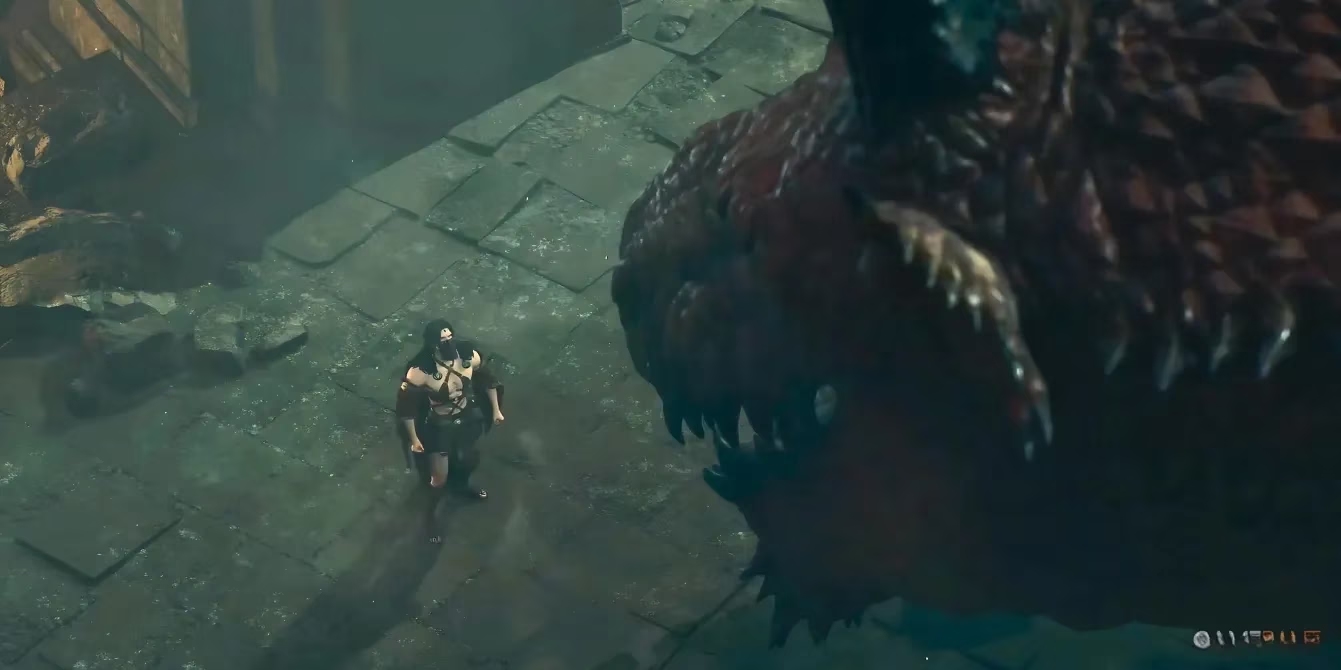
The October 2024 patch was not just another footnote in the patch notes; it was a recalibration of the very heart of Dragon’s Dogma 2 on living-room screens. Until that moment, the game had simmered in a single, unyielding visual mode that often throttled the frame rate into the 30s, occasionally dipping as low as a candle flame flickering in a draft. Capcom, aware of the discontent that simmered louder than a drake’s roar, had been gradually improving the PC version, but console players felt they were running through Gransys with one foot in quicksand. The new update introduced two selectable options: “Prioritize Graphics” and “Prioritize Performance.” The naming was simple, yet the impact was as if someone had finally cleared the fog from a navigator’s sextant. In performance mode, the PS5 and Xbox Series X each targeted a rendering of 1728p while unlocking a frame rate that hovered between 50 and 60 FPS — a silky, responsive flow that made climbing cyclops faces and parrying goblin strikes feel immediate and visceral. In graphics mode, the resolution soared to a crisp 2160p (4K) with a more modest 30 to 40 FPS, offering the painterly landscape at its most opulent.
Even the humble Xbox Series S, often viewed as the squire to its bulkier siblings, saw a meaningful transformation. The budget console rendered at 1440p regardless of the chosen mode, but the frame rate nudged from a drifty 30-35 FPS in graphics mode to a more stable 35-40 FPS in performance mode. It wasn’t a radical leap, but for a platform so often left in the dust, this update felt like finding a hidden grimoire that whispered a forgotten spell. Capcom released a detailed chart alongside the patch, outlining the exact resolutions and frame-rate targets for every machine — a move that was both technically transparent and psychologically reassuring. Players could now choose between the blade of motion and the shield of beauty, a decision that echoed the very duality the game’s narrative often explored.
But why was this moment so pivotal, especially looking back from the vantage point of early 2026? Because that October 2024 patch was the fulcrum on which the game’s post-launch reputation pivoted. At the time, Dragon’s Dogma 2 had already sold tremendously well — despite the microtransaction debates and the infamous dragonsplague that could depopulate entire cities. Yet those frame-rate tribulations were a stubborn wedge between the experience and the community. The performance mode sliced through that wedge like a well-timed Arc of Obliteration. It proved that Capcom was not simply counting its coins and moving on; the developer was tending to its garden, pulling out dead roots so that new growth could flourish. In a way, the game was like a phoenix that had already risen, but whose wings needed realigning before it could truly take ownership of the sky.
This careful stewardship soon bore fruit. Throughout 2025, whispers of a Dragon’s Dogma 2 expansion grew louder, stoked by Capcom’s own surveys that had asked players if they craved more — more vocations, more realms, more unscripted epicness. The original Dragon’s Dogma had received the Dark Arisen DLC roughly a year after its launch; history seemed to be uncannily rhyming. And indeed, as many now know, the “Vermundian Tides” expansion arrived in the first quarter of 2025, a mere few months after the performance patch had polished the base game’s imperfections to a high sheen. That DLC, with its maritime questlines and the mysterious Coral Pawn guild, would not have landed with the same force had it launched on top of an unstable foundation. The October 2024 update was the unseen architect of that success, the quiet hero that allowed players to face the brine-spawned horrors of the new content without the distraction of stuttering.
By 2026, the tale of Dragon’s Dogma 2’s redemption has become a case study in after-launch stewardship. The performance mode wasn’t merely a checkbox; it was a promise kept after months of silent toil. For players who had once felt their console was holding the game back, the patch was akin to finally swapping a worn-out lantern for a star-lit sky — suddenly every detail, from the wet sheen on a saurian’s scales to the frantic dance of a griffin trapped in a maelstrom, could be perceived without compromise. The frame-rate mode became so deeply integrated that it’s easy to forget the game once existed without it. Yet, those who remember the launch days recall the tangible moment when the update downloaded, and the world snapped into a new, fluid pulse. The Arisen no longer had to wrestle the executioner’s blade of lag; they could simply wield their own sword and carve their legend. And in doing so, Dragon’s Dogma 2 cemented not just its commercial legacy, but its enduring, community-driven soul.
The journey of Dragon’s Dogma 2 is a testament to the evolving landscape of gaming, where post-launch updates and community engagement play pivotal roles in a title's success. As players continue to embark on epic quests and explore the game's rich environments, finding cost-effective ways to access this digital world becomes equally important. In an era where gaming expenses can quickly add up, seeking out platforms offering competitive game prices is a smart move for any gamer.
For those looking to dive into Dragon’s Dogma 2 or expand their collection with other thrilling titles, discovering the cheapest steam keys can make a significant difference. Websites like DealNest provide an excellent solution, offering gamers the opportunity to acquire their favorite games at unbeatable prices. Whether you're a veteran Arisen or a newcomer eager to experience the captivating adventures that await, these deals ensure you can enjoy your gaming journey without breaking the bank.