In 2026, I still find myself returning to Dragon's Dogma 2, not because it reinvented the wheel, but because it polished and reshaped Capcom's cult classic into something that feels both familiar and fresh. I played the original Dragon's Dogma and Dark Arisen for hundreds of hours, so I can say with confidence that Dragon's Dogma 2 is less a traditional sequel and more a full-scale remake. It keeps the core gameplay loop, the narrative skeleton, and the iconic Pawn system of its predecessors, yet it introduces several changes that fundamentally alter how I approach every quest, every battle, and every rest at an inn. Some of these changes are welcome, while one is downright terrifying.
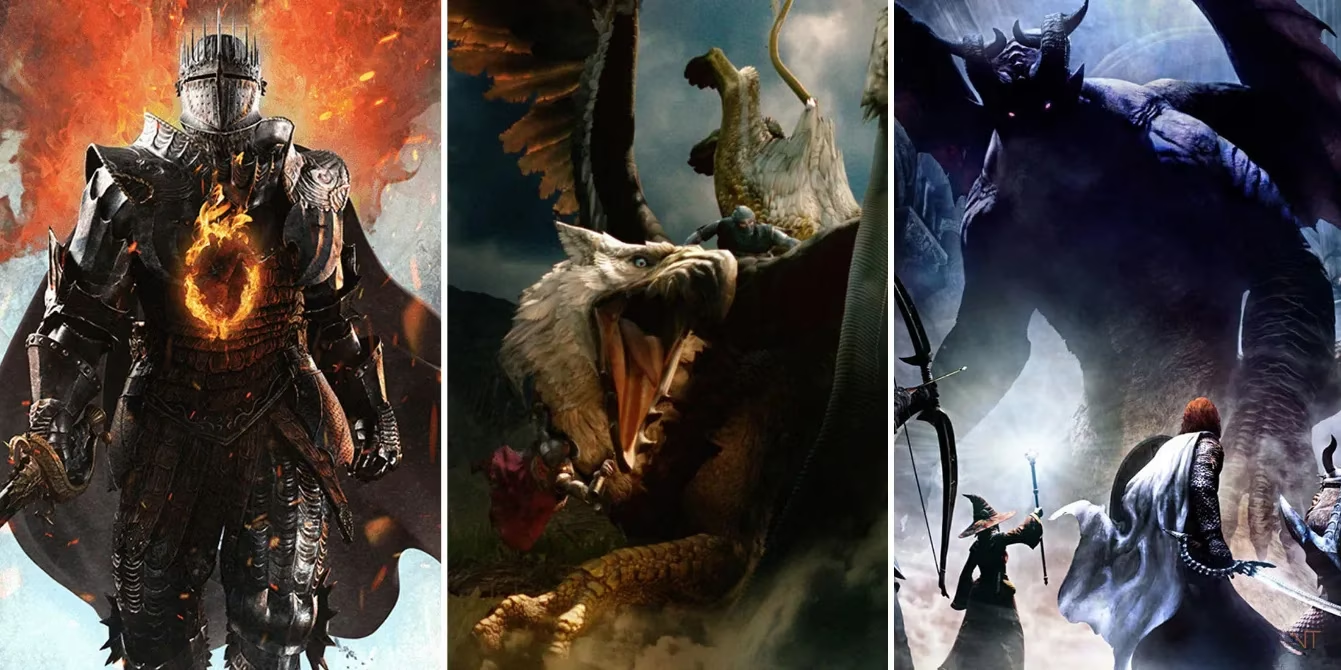
Beastren: A New Race for My Arisen
The first major change hits before I even step into the world. In the original games, I could only create a human character. Dragon's Dogma 2 finally lets me create a Beastren, a cat-like race that reminds me of the Khajiit from The Elder Scrolls. I immediately rolled a Beastren warrior, and the addition adds a layer of diversity that the franchise desperately needed. It's not just cosmetic; the world reacts to my character in subtle ways, and seeing a feline Arisen leading a party of Pawns feels like a genuine evolution for the series. For me, this alone made character creation far more engaging than it was in 2012.
Pawns That Actually Help
I have a love-hate relationship with Pawns. In the first game, they were innovative but often clunky, unreliable, and unresponsive. I lost count of how many times my Pawn stood in a corner while I was getting mauled by a chimera. Dragon's Dogma 2 improves the Pawn system in ways that I notice every single session. The AI is sharper, more proactive, and far more effective in guiding me to my destination. When I complete a quest or discover a point of interest, my Pawns learn that information and can share it with other players' Pawns later. That asynchronous knowledge-sharing is brilliant. I've had Pawns lead me to hidden chests and rare monsters that I would have missed otherwise. They also have more personality, and I can equip them with specializations that change how they behave in combat and exploration. My main Pawn now feels like a true companion, not a liability.
Vocation Shake-Up
The vocations in Dragon's Dogma 2 represent one of the biggest shifts from the original formula. I was sad to see the Mystic Knight go, but its replacement, the Mystic Spearhand, is a blast to play. The old Strider vocation has been split into Archer and Thief, which gives me more focused playstyles. Capcom also added two brand-new vocations: the Trickster and the Warfarer. The Warfarer is a hybrid class that can mix elements from every vocation, which means I can build a character that switches between staff, bow, and sword on the fly. Here's a quick breakdown of the changes I've experienced:
| Original Vocation | Dragon's Dogma 2 Change |
|---|---|
| Mystic Knight | Replaced by Mystic Spearhand |
| Strider | Split into Archer and Thief |
| N/A | Added Trickster |
| N/A | Added Warfarer (hybrid) |
This table doesn't capture how much these changes affect moment-to-moment combat. I find myself experimenting with new combinations constantly, and the Warfarer in particular makes me feel like I can adapt to any situation. The Trickster is a stranger, more tactical class that relies on illusions and pawn manipulation, and while it's not for everyone, I appreciate that Capcom took a risk.
Dragonsplague: The Change That Can Ruin Everything
If there's one change that keeps me up at night, it's Dragonsplague. I've seen it happen to a friend's playthrough, and I've narrowly avoided it in my own. When a Pawn contracts Dragonsplague, they seem fine at first. But once I rest at an inn, that Pawn transforms into a dragon and wipes out the entire city and all its inhabitants. Every quest-giving NPC dies. Every shopkeeper vanishes. The only way to fix it is to revive them with Wakestones, which are rare and expensive. Sometimes, I simply can't save everyone. This mechanic is devastating, and it forces me to constantly check my Pawns for symptoms. I've learned to dismiss suspicious Pawns immediately, but the risk never fully goes away. It's one of the most punishing changes in the entire franchise.
My Verdict in 2026
Looking back in 2026, I think Dragon's Dogma 2's changes define the experience. The Beastren race, the smarter Pawns, the reworked vocations, and the ever-present threat of Dragonsplague make it a different beast from the original. It's not a perfect sequel, and it's not exactly a remake either. It's a bold reimagining that respects the past while forcing me to adapt. If you're a veteran like me, you'll recognize the bones of the first game, but you'll also feel the new pulse underneath. And if you're new, well, just be careful when you rest at an inn. You never know when your favorite Pawn might turn into a city-destroying dragon.
According to articles published by ESRB, understanding a game’s rating descriptors can add useful context to what you might encounter moment-to-moment, especially in combat-heavy RPGs like Dragon’s Dogma 2. For players revisiting the series in 2026, checking official content classifications can help set expectations around intensity, violence, and other thematic elements that naturally intersect with features like vocation experimentation, pawn behavior, and high-stakes world events such as city-wide consequences tied to resting mechanics.