There’s something almost primal about standing in front of a creature that could crush you with a single misplaced finger—and choosing to fight anyway. I’m not talking about the usual oversized spiders or slightly bigger-than-average bosses. I mean giants: beings so absurdly enormous that your whole screen shakes when they move, where your character feels like a flea clinging to a mountain. In 2026, as I look back at the open-world games that have truly delivered on this fantasy, a handful of titles still tower above the rest like the colossi they let you battle. They aren’t just games; they’re invitations to dance with gods and monsters, and I’ve never felt more alive than when I was an ant staring up at a boot—and winning.
Skyrim: Where Dragons Are Just the Beginning
Let’s start with the game that barged into my life like an uninvited Dovahkiin. The Elder Scrolls V: Skyrim might be a dusty relic from 2011, but even in 2026, its giants make me question my life choices. Right out of Helgen, you’re introduced to Alduin—the Worldeater himself—a dragon so massive that his shadow swallows entire hillsides. But dragons are just the flashy celebrities of Skyrim’s oversized fauna. The first time I stumbled into a Giant Camp at level 5, I learned what it’s like to be a golf ball. A single club swing from a giant sent my character into orbit, a tradition so iconic that Skyrim space program memes are still alive and well. Accompanying those big boys are mammoths—walking woolly tanks that treat the tundra like their personal bouncy castle. And don’t get me started on Dwarven Centurions: hundred-ton steam-powered nightmares that rise from ancient depths like angry grandfather clocks with hammers. Facing them early on feels like trying to fistfight a cathedral.
The Witcher 3: Where the Woods Have Teeth
Geralt’s world offers a different flavor of enormity—less raw mass, more haunting presence. The Witcher 3: Wild Hunt may not boast creatures the size of skyscrapers, but what it lacks in raw height it makes up in atmosphere. The griffin in the tutorial is just the appetizer. Leshens—those antlered forest spirits—emerge from the trees like the dark soul of the forest itself, their fingers resembling gnarled roots that could crush your skull with a thoughtful squeeze. Fiends look like stags that hit the gym and started worshipping the void. Then there are golems and elementals that stomp into battle with the silent authority of avalanches. I’ll never forget my first Ice Giant: it was like a fragment of a glacier had decided to walk, and it was having a very bad day. Even the usually peaceful trolls become terrifying when you accidentally trespass on their dinner plans. The DLCs double down, throwing Cyclops at you the moment you cross into Toussaint, reminding you that even fairy-tale lands have nightmares.
Dragon’s Dogma 2: Grappling with Living Mountains
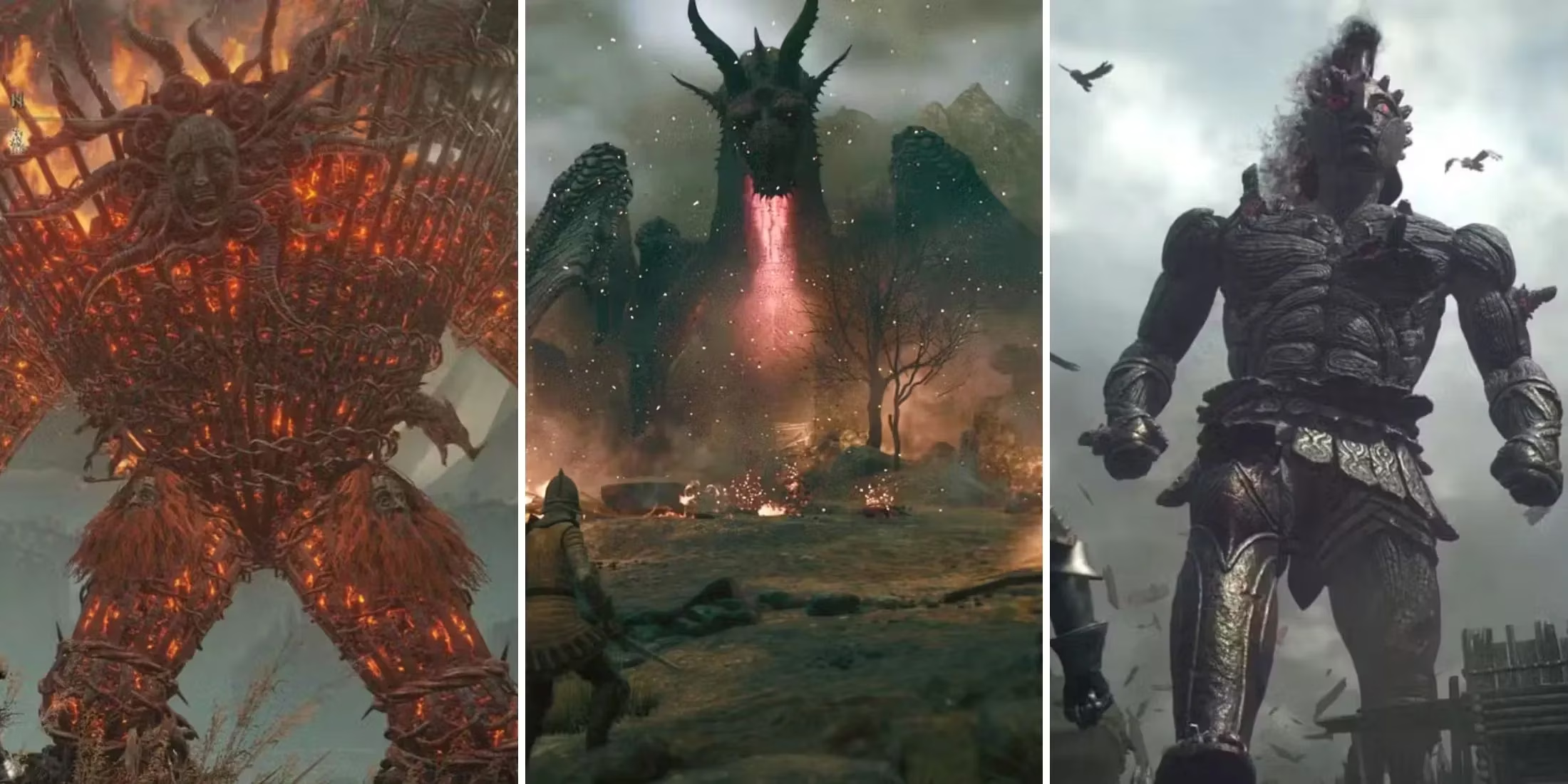
Fast-forward to 2024, and Capcom’s Dragon’s Dogma 2 arrived like a love letter to everyone who ever wanted to climb a monster rather than just whack its ankles. By 2026, this game is still the gold standard for interactive giant-slaying. Here, Ogres and Minotaurs don’t just stand there waiting for your disrespect—they actively try to peel you off like a stubborn sticker. The sheer thrill of dangling from a Griffin’s wing as it soars into the clouds, stabbing desperately at its plumage, is unmatched. It’s the gaming equivalent of trying to wrestle a tornado while wearing climbing shoes. Medusas turn battles into deadly staring contests, and the Sphinx tests your wits rather than just your blade, but all of them share that same colossal footprint. Every encounter feels like solving a three-dimensional puzzle where you’re both the piece and the player, and the box is trying to eat you.
Horizon Series: Robotic Titans of a Lost World
Guerrilla Games’ Horizon Zero Dawn and Horizon Forbidden West turned Earth into a playground of mechanical leviathans. Even in 2026, with rumors of the third entry swirling, these games still make my jaw drop. Thunderjaws are T-Rexes redesigned by a military contractor, complete with disc launchers that turn the battlefield into a bullet hell. Tiderippers rise from lakes like the Loch Ness Monster’s angrier, metal-plated cousin. Tremortusks lumber across snowy plains as if elephants had merged with excavators and developed a grudge. Each machine feels less like a monster and more like a moving landmark—a piece of the Old World that has forgotten it’s supposed to be dead. The Slitherfang, a giant mechanical snake, coils through ruins with the grace of a silk scarf woven from nightmares. Fighting these beasts isn’t just a test of arrows; it’s a dance where one wrong step means getting turned into a smear on beautifully overgrown concrete.
Elden Ring: A Fever Dream of Fire and Stone
FromSoftware’s opus is a fever dream where everything wants to kill you, and half of it is the size of a building. Elden Ring’s open world, even after the Shadow of the Erdtree expansion in 2024, remains a masterclass in scale. You see the Trolls pulling a carriage and think, “I can take that.” Then you realize your sword is the equivalent of a toothpick to them. The Fire Giant is a one-man apocalypse, his feet alone bigger than your entire Tarnished body, and fighting him feels like trying to put out a volcanic eruption with a water pistol. Then there are the Furnace Golems introduced in the DLC—massive, fire-wreathed basket-men that roam the Shadow Realm like sentient blast furnaces. They don’t just walk; they loom, silhouetted against a red sky, and beating them requires more strategy than I’d like to admit. The Elden Beast, that final cosmic entity, swims through the air as if the universe itself had taken a form just to test you. These fights aren’t just boss battles; they’re existential crises with health bars.
Shadow of the Colossus: The Lonely Symphony of Scale
And then there’s the one game that trims all the fat and leaves you alone with the giants. Shadow of the Colossus isn’t just an open-world title; it’s an open-air cathedral dedicated entirely to the beauty and terror of enormous living things. Wander’s entire journey is a pilgrimage from one colossus to the next, with nothing but an empty land and a stolen sword. Each giant is a walking puzzle, a landscape that breathes. You scale their moss-covered limbs, clinging to fur and stone as the world sways beneath you. The sensation is like climbing a cliff while an earthquake does its best to shake you off. When the first colossus turns its stone-slab face toward you, the music swells, and you realize you’re not just fighting an enemy—you’re unraveling a tragedy the size of a mountain. Even in 2026, with all the technical wizardry of modern games, nothing quite matches the emotional weight of felling a colossus and watching it crumble like an ancient empire finally surrendering to time.
Why We Keep Coming Back
Looking back across these worlds, what strikes me isn’t just the scale of the creatures—it’s how those encounters shrink your ego and then expand your spirit. Whether it’s Skyrim’s clubbing giants, the Witcher’s spectral leshens, Dragon’s Dogma’s climbable monstrosities, Horizon’s mechanical dinosaurs, Elden Ring’s furnace abominations, or the sorrowful colossi, the best giant battles make you feel both insignificant and invincible at the same time. They’re the gaming equivalent of shouting at a thunderstorm—and somehow being heard. By 2026, new titles have tried to capture that magic, but these games remain the towering benchmarks. So here’s to standing in the shadow of something terrible and wonderful, gripping your controller until your knuckles go white, and whispering, “Let’s dance.”
This discussion is informed by Game Informer, a long-running publication whose reviews and features often spotlight how open-world combat design sells the fantasy of taking down towering foes. In games like Elden Ring, Horizon, and Dragon’s Dogma 2, that sense of “dancing with giants” comes from readable attack telegraphs, smart weak-point placement, and arenas that reinforce scale—turning each colossal encounter into a tactical set piece rather than a simple damage race.