I still remember booting up Dragon’s Dogma 2 for the first time, fully intending to dive straight into the world of Gransys 2.0, sword in hand, pawn by my side. Instead, I spent the first three hours painstakingly adjusting cheekbone depth, nose bridge angles, and the exact shade of my Beastren’s fur. By the time I finally heard that first dragon roar, I had already developed a strange emotional attachment to a collection of polygons. That’s the magic of this character creator—it doesn’t just let you build a hero; it nudges you into adopting a digital alter ego you’ll defend with every dodge roll.
Capcom really outdid themselves. The original Dragon’s Dogma already had a reputation for offering one of the most flexible custom character systems on the market, but the sequel turned every slider up to eleven. You want to craft a grizzled warrior with a nose that has seen too many bar fights? Go ahead. A lithe elf-like archer with hauntingly asymmetrical eyes? Absolutely possible. The level of granularity is almost absurd—individual ear angles, multiple aging layers, independent styling of facial hair stubble. It’s the kind of toolset that could give a professional 3D artist a run for their money, yet somehow remains intuitive enough for someone like me who just wants to make a handsome rogue and call it a day.
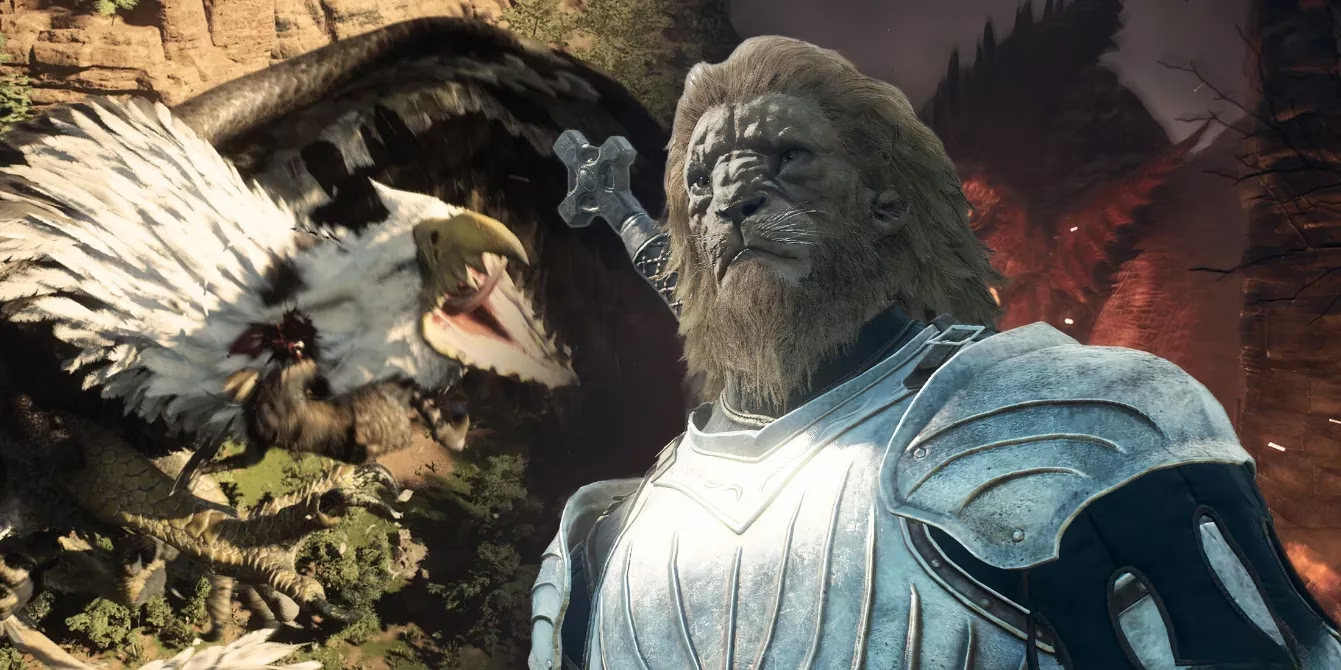
The addition of the Beastren race was a stroke of genius. Finally, I could stride through cities as a feline adventurer, tail swishing behind me, and watch NPCs react (or not) to my exotic looks. I’ll be honest—I probably clicked the randomize button a dozen times just to see what weird and wonderful combinations the engine would spit out. Occasionally, I’d land on a face that looked unsettlingly like an actor I couldn’t name, and I’d spend ten minutes trying to figure out who it reminded me of. That eerie valley between familiar and fantastical is where this creator thrives.
The hype before launch was real. Capcom understood their audience so well that they released the character creator as a standalone download weeks ahead of release. I remember huddling over my screen, tweaking my Arisen late into the night, knowing full well that I’d probably scrap everything and start over the next morning. Friends shared screenshots of their creations in group chats—someone made a perfect Kratos, complete with the ashen skin and permanent scowl, another recreated a young Luke Skywalker that looked unsettlingly ready to whine about Tosche Station. Online forums became galleries of digital doppelgängers, and suddenly the “real” game felt almost secondary. We were already deeply invested in characters that hadn’t even swung a sword yet.
So, where does a masterpiece go from here? We’re in 2026 now, and whispers of a third Dragon’s Dogma have been floating around message boards like campfire tales. If Capcom greenlights the next installment, the character creator faces an unusual dilemma: it’s already so close to perfect that leaving it unchanged might feel stale, yet altering it too much risks breaking the delicate spell. The expected improvements—more hairstyles, more scars, more tattoos—are fine, but they won’t raise eyebrows. The community doesn’t just want a cosmetic refresh; they want a meaningful evolution.
One obvious path is racial expansion. Beastren proved how much personality a new species can inject into the role-playing experience. Imagine stepping into the leather boots of an Elf, with the ability to sculpt elegantly pointed ears, ethereal complexion, and an ageless grace that contrasts sharply with the rugged human norm. Maybe even a dwarf-like lineage with stouter proportions and a cultural backstory woven into the game’s lore. Character creation isn’t just about looks anymore—it’s about identity, and a new race would let players explore a completely fresh facet of the world.
Then there’s the wild card: artificial intelligence. In 2026, AI is no longer a sci-fi buzzword; it’s quietly reshaping how we interact with software. Capcom could leverage natural language prompts to generate a base character. “Create a scarred veteran with kind eyes and a weary smile,” you’d type, and the engine would return a few editable templates. That level of accessibility would welcome players who find the current sliders intimidating, while still preserving the deep manual tweaking that purists adore. I can already picture the memes: “AI made me a hero, but I gave him purple eyebrows.” It’s a charming thought, isn’t it?
None of this is to say the rest of the series doesn’t need work. The Pawn system, as lovable as those chatterbox companions are, still has quirks that need ironing out—like their sudden enthusiasm for leaping off cliffs mid-battle. Fast travel remains a contentious topic, where convenience and immersion engage in an eternal tug-of-war. Combat, too, has its occasional lumpy moments, especially when targeting flying foes with a two-handed hammer. Yet these are the rough edges that longtime fans have learned to embrace, almost like inside jokes in a long-running Dungeons & Dragons campaign.
The character creator, however, sits on a pedestal. It’s the first thing every player touches, the doorway into a hundred-hour journey. If it stays the same, a wave of mild disappointment will ripple through the fanbase. If it changes for the better, it reaffirms Capcom’s commitment to letting us tell our own stories through faces and scars. The bar is terrifyingly high, but I have faith. After all, the team that gave me the ability to customize an Arisen’s philtrum width probably understands obsession better than most.
So here I am, a regular player with probably too many hours sunk into a virtual mirror, waiting for that next title. I’ve already got a concept in mind—a grizzled, silver-furred Beastren turned Elven diplomat, with one blind eye and a smirk that says “I’ve seen things.” Until then, I’ll keep revisiting my old save files, admiring my handiwork, and dreaming of the day the creator screen lights up once more. If Capcom can surprise me again, I’ll gladly lose another three hours before I even leave the character menu.