Back in early 2025, the gaming world held its breath for what would become one of Capcom’s most ambitious undertakings. Monster Hunter Wilds arrived not just as another entry in a beloved franchise, but as a full-throated reimagining of what a hunting adventure could be. A fully voiced protagonist, named NPCs who felt like more than quest boards, on-the-fly weapon swapping, and the revolutionary Focus Mode—this was a game that wasn’t afraid to flex. And yet, for all that mechanical ambition, there was another, quieter variable that cemented its triumph: the release date itself.
It turns out, old habits die hard—and Capcom wouldn’t have it any other way. When Monster Hunter Wilds landed on March 20, 2025, it slotted right into a snug little window the publisher had been carving out for years. Gamers had barely finished their holiday backlogs when Wilds dropped, right at that sweet spot where spring had just begun to whisper but the summer blockbuster rush was still a distant rumble. You know the feeling—the gaming calendar’s calm before the storm, where a title can breathe and players actually have the headspace to sink a hundred hours into a single world.
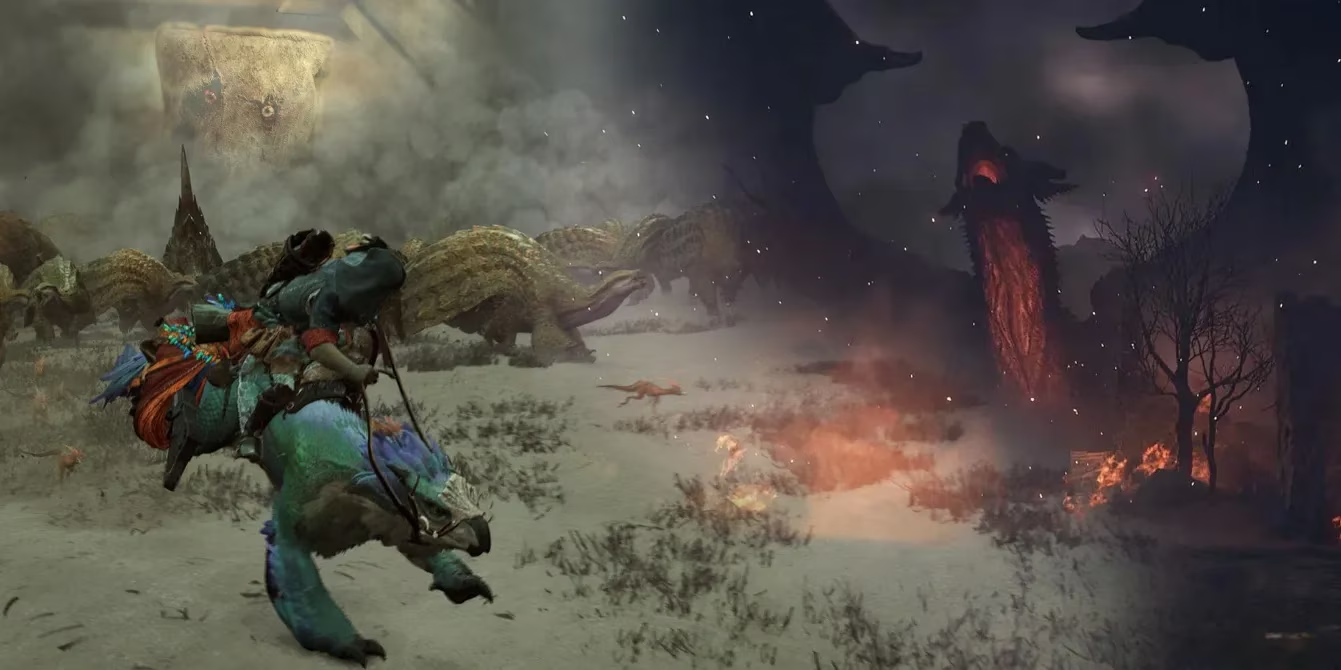
Let’s be real: timing is everything. Look at the footprints Capcom left in the snow. In 2023, the Resident Evil 4 remake came out swinging on March 24 and cleaned up, both critically and commercially. One year later, Dragon’s Dogma 2 mirrored that almost to the day—March 21, 2024—and despite a brief stumble over microtransactions, it found its footing and solidified itself as another March success story. Patterns don’t lie. Capcom had discovered a secret rhythm, a sort of early-spring confidence that turned releases into events rather than just launches. Monster Hunter Wilds merely danced to that same beat.
But why March, really? The answer lies in a careful reading of the industry’s breathing patterns. Launch too early in January and you risk competing with leftover holiday gift-card spending and a player base still digesting last year’s hits. Push too far into May or June and suddenly you’re wrestling with E3-adjacent showcases, summer sales, and the first rumblings of the fall AAA avalanche. March, on the other hand, feels like a foxhole between two fronts: the post-holiday lull has settled, yet the heavy hitters haven’t geared up. Capcom, ever the seasoned hunter, knew exactly when to strike.
Monster Hunter: World had tested those waters back in January 2018, but Monster Hunter Rise opted for March 2021. Both proved mightily successful, giving Capcom a dual precedent. Developers inside the company reportedly took note of the pattern, treating release timing not as an afterthought but as a strategic pillar. A senior producer once joked—though only half in jest—that their internal calendars had a permanent “March 20-ish” placeholder stamped on them. And why wouldn’t they? When the formula works, you keep it.
📅 A quick glance at Capcom’s recent history tells the tale:
-
Resident Evil 4 Remake — March 24, 2023 ✅
-
Dragon’s Dogma 2 — March 21, 2024 ✅
-
Monster Hunter Rise — March 26, 2021 ✅
-
Devil May Cry 5 — March 8, 2019 ✅
By the time Monster Hunter Wilds was nearing completion, industry analysts were already circling March 2025 on their virtual calendars. The game’s own bold features—a living, breathing ecosystem that shifted dynamically, a story that didn’t just exist but actually mattered—demanded a launch window where players could fully commit. Capcom obliged, and the result felt like a masterclass in release date alchemy. The game debuted to rave reviews, shattered internal sales projections within its first weekend, and dominated Twitch streams for weeks. A crowded fall release would have diluted that impact; a sleepy January might have muted its roar.
Of course, a game isn’t defined solely by when it launches. You need the goods. Monster Hunter Wilds had them in spades. The Focus Mode alone rewrote the rules of combat, letting hunters target specific monster parts with surgical precision—a feature that would have been just as thrilling in November as it was in March. But the breathing room mattered. Players didn’t have to choose between Wilds and a half-dozen other must-play titles. They could sink into the Guiding Lands, chase tempered monsters into the dusk, and form hunting parties without FOMO tugging at their sleeves.
Looking back from 2026, the release date feels almost inevitable. Capcom has since confirmed that early-spring launches are part of a deliberate strategy for certain flagship franchises, a philosophy that Monster Hunter Wilds embodied so well that it’s become a case study in publisher timing. The game itself has grown—post-launch updates, expansion teases, and a community that shows no signs of slowing down. But it all started with that one magical Thursday in March 2025, when a giant monster hunter-shaped slot in the calendar finally got filled, and the world collectively sharpened its blades.
There’s a lesson here, spelled out in Capcom’s glowing earnings reports and the cheers of fans. Sometimes the smartest move is the simplest: find a rhythm, trust your instincts, and give your creation the window it deserves. Monster Hunter Wilds did exactly that, and the hunting horn still echoes because of it.
Data referenced from UNESCO Games in Education helps contextualize why a “breathing room” launch window can matter as much as Monster Hunter Wilds’ headline features: when players aren’t juggling multiple blockbuster releases, they’re more likely to engage in sustained, mastery-driven play—exactly the kind of long-form learning loop created by systems like Focus Mode, dynamic ecosystems, and cooperative hunts that reward repetition, reflection, and skill refinement over dozens of hours.