The Japanese role-playing game genre has long been synonymous with epic, story-driven journeys, often guiding players along carefully scripted paths. For decades, this linear design was a hallmark, prioritizing narrative depth and character development over player freedom. However, as the gaming landscape has evolved, so too have the expectations of players. In 2026, a new wave of JRPGs has emerged, challenging the traditional formula by offering vast, explorable worlds where the story is just one part of a much larger adventure. These games empower players to forge their own paths, discover secrets at their own pace, and engage with the world on their own terms, creating a richer and more personalized experience that blends the genre's signature storytelling with the thrill of open-ended discovery.
Shin Megami Tensei V: Vengeance
While the main narrative of Shin Megami Tensei V: Vengeance unfolds in a direct manner, its world is anything but restrictive. The game represents a significant departure from pure dungeon-crawling, presenting players with expansive, interconnected regions teeming with life and danger. Each new area is a sprawling landscape inviting thorough investigation. Players are rewarded for their curiosity with hidden missions, formidable optional bosses, and demon-recruiting opportunities that exist entirely outside the critical path. The game's primary focus remains its deep and challenging turn-based combat system, a hallmark of the series, but this complexity is now set against a backdrop of meaningful exploration. The freedom to roam these desolate yet beautiful vistas makes every victory feel earned and every discovery personally significant.
Yakuza: Like a Dragon
Yakuza: Like a Dragon masterfully introduces its non-linear elements. The opening hours are deliberately linear, focusing on character introduction and narrative setup through extensive, cinematic cutscenes. Once protagonist Ichiban Kasuga is set loose in the Kamurocho district, the game transforms. Though the map is geographically compact compared to sprawling open worlds, it boasts an incredible density of content.
Players can:
-
Engage in numerous side stories (substories) that range from the heartwarming to the hilariously absurd.
-
Participate in a vast array of minigames, from classic Sega arcade titles to running a business management sim.
-
Grind for money and experience through various activities to purchase the best gear for Ichiban and his party.
This approach creates a living, breathing district where the main story is just one of many compelling threads a player can pull on, making the journey deeply personal and often wildly unpredictable.
Final Fantasy VII Rebirth
Building on the foundation of its predecessor, Final Fantasy VII Rebirth dramatically opens up the world of Gaia. After the linear, cinematic escape from Midgar, Cloud Strife and his party are granted a newfound freedom. The game presents large, distinct regional maps—from the sun-drenched Grasslands to the rocky cliffs of the Junon region—each designed as a playground for exploration.
These areas are filled with:
-
World Intel activities that encourage scanning every corner.
-
Chocobo racing and breeding.
-
Protorelic hunts and unique side quests that flesh out the world and its inhabitants.
-
A plethora of minigames at the Gold Saucer to break up the adventure.
The balance between a directed, emotional main narrative and the liberty to explore these rich zones at will is a defining achievement, offering a modern interpretation of the original game's world map freedom.
Dragon's Dogma 2
Dragon's Dogma 2 is a masterclass in systemic, player-driven exploration. It presents a vast, seamless world governed by a sense of tangible realism and danger. The game does not hold the player's hand; instead, it presents a world full of mysteries and challenges and trusts them to find their own way. The day-night cycle, dynamic enemy spawns, and the legendary Pawn system all contribute to an adventure that feels uniquely crafted for each individual.
Key exploration features include:
-
No fast-travel system in the traditional sense, encouraging overland travel and discovery.
-
Emergent gameplay moments, like being carried off by a Griffin to its distant nest.
-
Secret dungeons and caverns hidden away from the main roads.
-
The freedom to completely ignore the main quest and simply explore, hunt monsters, or aid villagers. This design philosophy makes every journey an unpredictable story in itself.
Octopath Traveler II
Octopath Traveler II leverages its unique narrative structure to facilitate non-linear exploration. Players begin by choosing one of eight protagonists, each with their own distinct story, motivations, and special Path Actions (like Allure or Steal). These individual tales can be experienced in almost any order, and players are free to recruit party members at their leisure.
This structure creates a compelling gameplay loop:
-
Choose a traveler and complete their opening chapter.
-
Explore the world to find other travelers and add them to your party.
-
Tackle any character's next story chapter, regardless of sequence.
-
Discover how the stories subtly intertwine through crossed paths and eventual convergence.
The beautiful HD-2D visuals make exploration a constant delight, rewarding those who venture off the beaten path with hidden dungeons, powerful weapons, and a richer understanding of the world's lore. It’s a game that truly makes the journey, not just the destination, the core of the experience.
Pokémon Scarlet & Violet
With Pokémon Scarlet & Violet, the long-running franchise fully embraced an open-world structure. The Paldea region is presented as a vast, seamless landscape that players can traverse from the outset. The game features three main story threads—the traditional Gym Challenge, the Titan Pokémon hunt, and the Team Star storyline—which can be tackled in any order.
| Feature | Description |
|---|---|
| Open World | A fully explorable Paldea with no forced progression gates. |
| Non-Linear Objectives | Three main questlines can be completed in any sequence. |
| Gym Order Freedom | While gym leaders' levels are fixed, players can challenge them out of order. |
| Let's Go Mode | Allows Pokémon to auto-battle in the overworld, facilitating exploration. |
Despite some technical performance issues at launch, the game's core design represents a bold and largely successful shift for the series, emphasizing player choice and exploration over rigid linearity and setting a new precedent for future mainline titles.
Xenoblade Chronicles X
As a Wii U title that remains a cult classic, Xenoblade Chronicles X stands as a towering achievement in open-world JRPG design. The planet Mira is a breathtaking, biome-diverse world begging to be explored. From the crystalline forests of Primordia to the fungal plains of Noctilum, every region feels alien and full of wonder. The game's story is more straightforward, but it serves as a catalyst to push players into the world's vastness.
The crown jewel of exploration is the Skell mechanic. These customizable, transformable mechs are not just late-game unlocks; they are integral to traversal, allowing players to run, jump, and eventually fly across the continents. The sense of scale and freedom offered by piloting a Skell over a previously impassable canyon or discovering a hidden continent is unparalleled. The game is packed with hundreds of side quests, affinity missions, and territorial conflicts that make the world feel alive and reactive, cementing its status as a pinnacle of non-linear JRPG exploration.
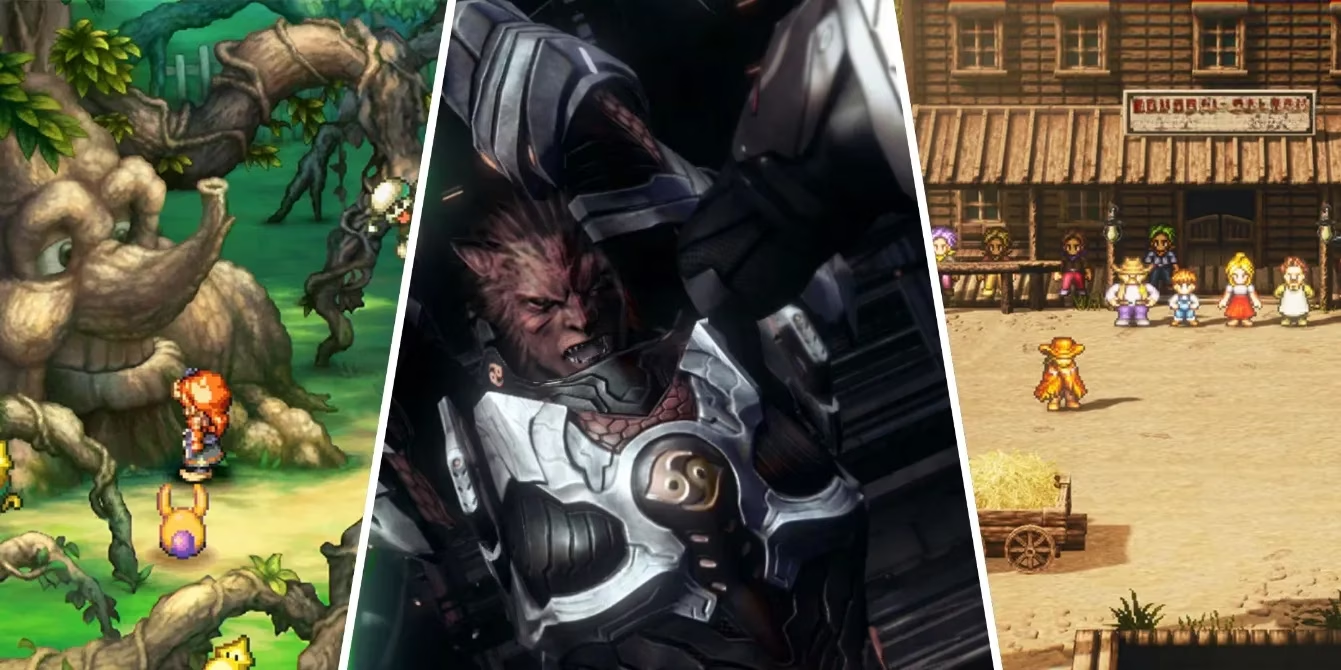
Legend of Mana
Legend of Mana takes a radically different approach to non-linearity through its innovative Land Make system. Instead of exploring a pre-built world, players literally build it themselves by placing artifacts on a blank canvas. Each artifact placement generates a unique area—a town, a dungeon, a forest—complete with its own quests, characters, and rewards. This mechanic hands unprecedented creative control to the player, determining not only the order of events but the very geography of their adventure.
The game features:
-
Multiple story arcs that can be triggered based on artifact placement and player actions.
-
Three distinct main storylines that intertwine.
-
Varied endings influenced by player choices throughout the journey.
This design creates a highly personalized and replayable experience where no two playthroughs are exactly alike, making Legend of Mana a timeless example of player-driven, non-linear storytelling.
The Future of Exploration
As of 2026, the trend toward non-linear exploration in JRPGs is stronger than ever. These games prove that deep, compelling narratives and vast, player-driven worlds are not mutually exclusive. They offer a powerful alternative to the strictly linear model, valuing player autonomy, curiosity, and creativity. Whether it's through building the world itself in Legend of Mana, traversing continents in a mech in Xenoblade Chronicles X, or simply getting lost in the side stories of Kamurocho, these titles provide a richer, more immersive form of adventure. They remind players that sometimes, the most memorable stories are the ones they create for themselves along the way. The evolution continues, promising even more expansive and liberating worlds for JRPG fans to lose themselves in for years to come.
Data referenced from HowLongToBeat helps contextualize why modern, exploration-forward JRPGs feel so liberating in 2026: sprawling zone-based adventures like Final Fantasy VII Rebirth or fully open experiences like Pokémon Scarlet & Violet naturally expand playtime as players chase optional bosses, side quests, and collectibles at their own pace, turning “main story” progress into just one thread within a much longer personal journey.